
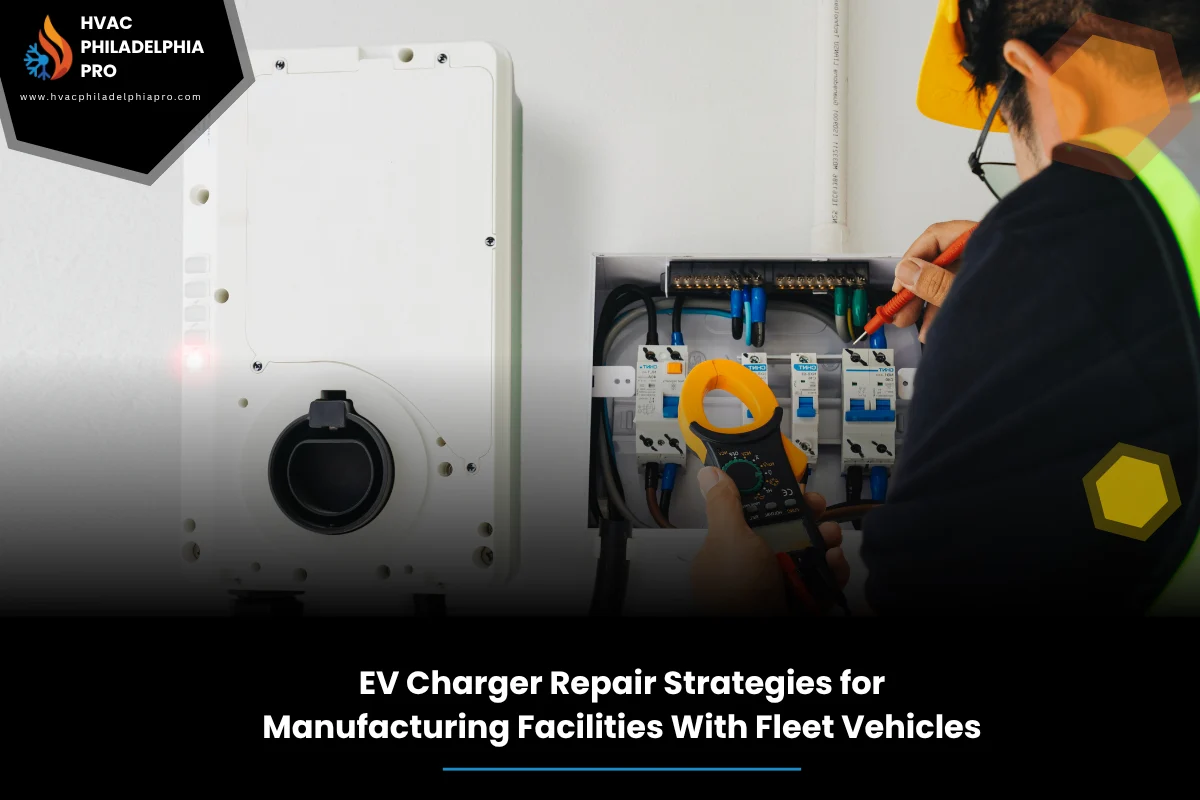
Manufacturing fleets move on tight schedules. When chargers stall, forklifts wait, drivers idle, and orders slip. A strong plan for EV charging station repair in Philadelphia keeps your plant running. It blends good design, safe work practices, sharp diagnostics, and clear roles so downtime stays short and predictable.
HVAC Philadelphia Pro works across electrical, HVAC, plumbing, and generators, so we see how one weak link can ripple through a facility. That cross-trade view helps you shape a repair strategy that fits your floor, your power, and your operations.
If you need to move from planning to action, consider EV charging station repair in Philadelphia to address plant-specific issues with safe, timely work.
Table of Contents
Quick Summary
A plant-ready repair strategy maps how to detect, isolate, and fix charger faults fast. You set roles, stock spares, track logs, and use a simple decision tree for on-site fixes, swaps, or RMA. Train teams on safety, document steps, and review patterns monthly. That creates a living response plan that cuts downtime without guesswork.
You do not need to start from scratch. Use a root-cause workflow, a parts kit list, and a troubleshooting playbook for power, comms, and connector issues. Align with your electrical safety program and keep clean records so repeat failures get solved at the source. Reference the broader guide on EV charger repair for context across homes and businesses.
Why Manufacturing Fleets Need a Repair Strategy
Fleet charging is a system, not a single box on a wall. Switchgear, transformers, network gear, and chargers all tie together. For a deeper baseline on common issues and scopes, see Complete Guide to EV Charger Repair in Philadelphia PA for Homes and Businesses and map those basics to plant operations.
Build around your shift patterns and power windows. Night shift might allow longer work blocks, while day shift needs rapid swaps. Aim every step at downtime mitigation so vehicles return to service on schedule.
Common Failure Modes in Industrial EV Chargers
Most issues fall into a few buckets. Input side faults like tripped breakers or loose lugs lead to EV charger power failure. Output side faults include overheated connectors, damaged cables, or contact pitting from frequent cycles. Communication faults appear as OCPP errors, network drops, or pilot signal failures.
Ground faults trigger protective trips. In those cases, plan for EV charger electrical fault repair that starts with insulation checks and neutral-to-ground testing. Keep a short list of these categories as your on-site failure classification to speed triage.
Root-Cause Workflow for Faster Downtime Recovery
Use this simple framework so your team runs the same play every time. It keeps steps tight and records clean.
- Stabilize the area: make safe, post signage, and confirm lockout points.
- Verify symptoms: read charger display, check logs, and confirm vehicle behavior.
- Power path check: source to charger input to output, looking for obvious opens or trips.
- Signal path check: pilot signal, network link, backend status, and OCPP queues.
- Module isolation: swap suspect modules or cables with known-good spares.
- Document findings: capture photos, meter readings, and error codes.
- Restore and observe: monitor a full charge cycle to confirm stability.
When you need a broader refresher on the fundamentals, review the complete guide on this topic for supporting concepts and basic repair context before tailoring steps to your plant.
Make this your living SOP. Tie every step to tickets, so repeat faults point to deeper root cause analysis rather than quick fixes alone.
Electrical Safety and Compliance Basics for Plant Environments
Charger work sits inside your broader electrical safety program. Confirm lockout points, arc flash boundaries, PPE, and permits before touching panels. Also verify grounding and bonding to avoid nuisance trips and hidden faults.
According to OSHA (2024), applying proper lockout tagout steps lowers the risk of unexpected energization during servicing and maintenance.
Train the repair team on your local procedures and make audits routine. Good safety habits reduce errors and speed up clean, repeatable work.
Building a Spare Parts and Tools Kit for the Plant
Your goal is a same-shift fix when possible. Keep items that fail most: handles, cables, pilot-signal boards, fuses, relays, comms modules, and labels. Stock a compact meter kit and torque tools sized for your gear. That is your on-site spare parts inventory.
- Cables and connectors rated for your charger models
- Contact kits, fuses, relays, and terminals
- Network gear: spare switch, patch cables, SFPs
- Meter, clamp meter, insulation resistance tester
- Label set, heat shrink, ferrules, and lugs
Data and Monitoring: Using Logs to Prevent Repeat Failures
Enable charger logs, backend alerts, and SNMP traps if available. Track error codes by unit and time of day. That forms a pattern map so fixes target the right cause. Pair this with maintenance windows to plan updates and firmware during low load.
Shift from calendar-only PM to light condition-based maintenance. For example, rising connector temps or frequent OCPP drops can trigger early checks before a line stops.
Coordinating With an EV charger electrician in Philadelphia
Some issues need licensed help. When you call, share logs, symptoms, and what you already tested. That speeds diagnostics and reduces trips. A clear scope of work also helps align parts and permits.
Use your ticket system to track handoffs. If you handle first-pass EV charger troubleshooting in Philadelphia on site, techs can jump straight to the likely fault area.
Choosing the Right Repair Path: On-site, Swap, or RMA
Pick the route that returns vehicles to service fastest while keeping safety first. Use this quick comparison to guide the call.
| Path | Best For | Pros | Cons |
|---|---|---|---|
| On-site Repair | Clear, localized faults | Fast return, minimal logistics | Needs trained staff and parts |
| On-site Swap | Suspected module or handle | Very quick, isolates cause | Requires spare inventory |
| Vendor RMA | Deep or warranty issues | Factory-level fix | Longer turnaround, shipping |
Keep a small pool of compatible modules for a rapid on-site swap, especially for high-use lanes.
Troubleshooting Playbook: Quick Checks by Fault Type
Use these fast checks to cut to the chase. Document every step so the next tech has a clean trail of clues and diagnostic checkpoints.
- Power failure: verify upstream breaker, lug torque, and voltage at input; test with meter before energizing.
- Ground fault trips: run insulation resistance test on cable and handle; inspect for moisture or damage.
- No start or early stop: check pilot signal, proximity switch, and vehicle handshake; inspect contactors for wear.
- Network errors: confirm switch power, link LEDs, backend status; test a known-good patch cord.
- Overheat warnings: clean vents, inspect fans, scan temps; reduce load and retest.
For stubborn EV charger power failure cases, swap to a known-good handle or module to isolate the suspect part fast.
Sustaining the Program: Reviews, Training, and Documentation
Hold a short monthly review. Look for repeat codes, parts usage, and trending weak points. Update your SOP and spares list based on what actually breaks. Keep photos, torque values, and firmware notes with each unit record.
Run quick toolbox talks for new hires and refreshers for the core team. A steady rhythm of continuous improvement keeps the system healthy.
FAQs
- What should I check first when a charger stops mid-shift?
Confirm safety, then verify input power, breaker status, and visible damage. Pull logs for error codes. Try a known-good cable or module to isolate the fault.
- How do I tell if it is a charger issue or a vehicle issue?
Test a second vehicle on the same charger, and the original vehicle on a different charger. If the fault follows the charger, continue with charger diagnostics.
- When should I call a licensed electrician?
Anytime you face panel work, unknown energization risk, repeated trips, or repairs beyond your permit or training, involve a licensed pro.
- What spare parts deliver the biggest uptime gains?
Handles, cables, fuses, contactors, and a comms module for your model. Pair with a reliable meter and labeled torque tools.
- How often should I review firmware or backend settings?
Schedule during low-load windows, then validate with a monitored charge. Log the version, time, and any new behavior.
- Can heat or dust cause frequent faults?
Yes. Clogged vents and high ambient temps push components past limits. Clean intake paths and verify fan operation as part of routine checks.
- What records matter most for repeat failures?
Error codes, meter readings, photos, parts swapped, and time of day. These make patterns clear so fixes solve the root cause.
Conclusion
Strong repair strategies protect fleet schedules and plant throughput. Tie safety, diagnostics, and spares into one clear playbook for faster fixes and fewer surprises. Keep reviews steady, train the team, and track logs so trends surface early. When you need specialized help with EV charging station repair in Philadelphia, share clear notes and test results to speed resolution.
Use the lessons from broad guides on home and business charger repair and tailor them to your line, your panels, and your shift rhythm. Contact HVAC Philadelphia Pro for expert assistance. With a calm plan and clean records, your fleet stays charged, your shifts stay on time, and your team stays safe.
continue reading
Related Posts
Learn practical steps for EV charger troubleshooting in Philadelphia. Keep distribution centers moving with safe triage, common fault cues, and when to call emergency help.
Learn Level 2 charger repair best practices for industrial sites using heavy equipment. Get safe workflows, diagnostic steps, breaker tips, and maintenance plans.
Learn how warehouses can cut delays with EV charging station repair in Philadelphia. Get fast triage steps, upkeep routines, and parts strategies to keep chargers online.