
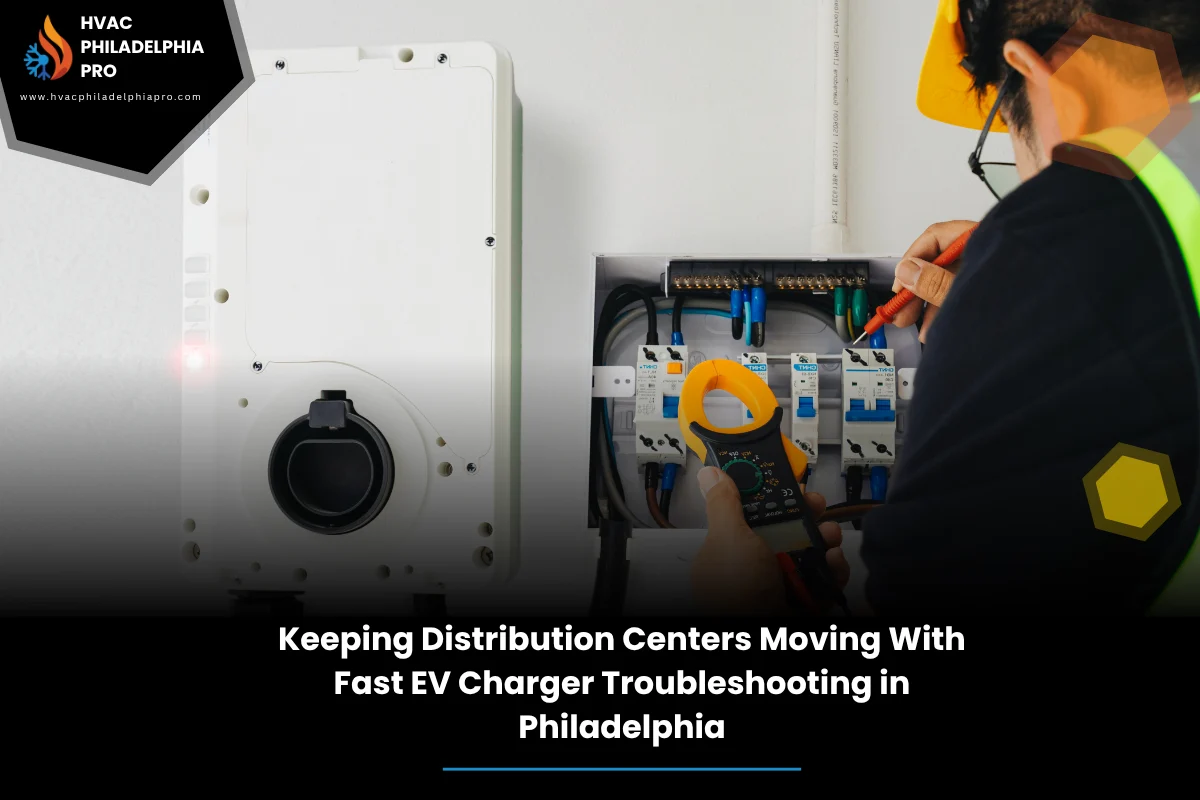
When loads stack up, minutes matter. If a yard tractor or delivery truck cannot charge, dock turns slip and routes fall behind. That is why teams need clear, simple steps for EV charger troubleshooting in Philadelphia that work in the real world, not just on paper. This guide focuses on practical checks any distribution center can use to keep lines moving.
For a deeper walk-through of service-level help, see EV charger troubleshooting in Philadelphia for structured support when an issue will not clear fast.
HVAC Philadelphia Pro works across complex building systems every day. We know how power, networking, and safety tie together on a busy dock. Use this playbook to stabilize faults, decide when to escalate, and protect uptime while staying safe.
Table of Contents
Quick Summary
Distribution centers depend on working chargers to keep forklifts, yard tractors, and delivery EVs ready. This article shows how to spot the pattern behind a fault, make safe first checks, and decide when to call in emergency help. You will see common symptoms, fast triage steps, and a simple table to steer on-the-spot choices.
We cover safety first, then a repeatable framework you can train across shifts. You will learn the difference between a charger issue and a site power problem, and what to document so the next shift can move faster. The goal is steady uptime and fewer surprises during peak hours.
Why downtime hits distribution centers hard
Every stalled charger can ripple through staging, pick paths, and delivery windows. When chargers queue, drivers wait, and the clock keeps ticking. A simple fault can turn into missed cutoffs without clear downtime mitigation.
For a deeper background on components and repair paths, read the Complete Guide to EV Charger Repair in Philadelphia PA for Homes and Businesses, then adapt those ideas to dock flow and shift timing at your site.
The pillar guide explains parts and repair logic. Here, we tailor the same repair thinking to the pace and risks inside distribution centers, where trucks, people, and pallets move at once.
Common EV charger faults in warehouses
Teams often report generic messages like EV charger not working. That can hide many root causes. The most common categories include ground faults, comms timeouts with the vehicle, connector wear, and site power issues. Quick pattern spotting saves time.
EV charger power failure hints at a supply issue upstream. If more than one unit drops together, think panel, breaker, or utility. A single unit going dark points to its feed, internal fuse, or controller. Solid process and good notes help your techs focus on the right tier of checks, including ground fault detection at the device.
Random fault codes without load change can point to loose terminations or an overheated handle. Heat and dust near docks make connectors age fast. Watch for corrosion on pins and cracked cable strain reliefs.
Safety first in a live facility
Before any panel check, stop traffic at the unit and set cones. Treat every enclosure as energized until proven otherwise. Use insulated tools and follow your site’s electrical safety rules. Reset only what you are authorized to reset.
Verify power off with a meter before touching conductors. Respect lockout rules, and never bypass interlocks. Consistent lockout and tagout habits protect people and prevent repeat trips.
Rapid triage framework for busy docks
Use this fast, repeatable process to clear simple issues and prepare clean notes for deeper support. For broader context on parts and repair logic, see the complete guide on this topic and align it with your facility playbook.
This method keeps teams calm and focused under pressure. It is a step-by-step triage flow built for shift leads and yard staff.
- Stabilize the area. Cone off the charger and clear vehicle movement near cables.
- Note the symptom. Is the screen dead, code showing, or session stalling at start?
- Check basics. Inspect connector pins, cable cuts, and emergency stop buttons.
- Power path. Confirm breaker ON at the local disconnect. If safe and trained, check the panel breaker state.
- Soft reset. If allowed by SOP, reboot the charger via menu or power cycle per the OEM guide.
- Retest with a known-good vehicle. If the fault repeats, capture timestamp, code, and steps tried for the next tier.
When to call emergency EV charger repair in Philadelphia
Stop local work and escalate fast if you smell burning, see arcing, or find damaged insulation. Also escalate if multiple chargers fail at once or a panel breaker trips again after a reset. That is a sign the issue sits upstream and needs expert incident stabilization.
During a surge of trucks, do not guess. Call emergency EV charger repair in Philadelphia when frontline checks do not hold. If a unit needs more than basic triage, it likely needs EV charging station repair in Philadelphia that covers internal boards, contactors, or comms modules.
Remember the big picture from the complete guide to EV charger repair for homes and businesses: keep people safe, protect equipment, and restore service in the right order. Good notes and photos speed the fix.
Preventive upkeep and uptime habits
Small habits pay off. Wipe connectors weekly. Keep cable whips off the ground to avoid forklift damage. Clear dust from vents. Log temperature alarms and fan noise. Rotate usage if a bank of chargers runs hot during the afternoon shift. These steps form the core of preventive maintenance.
According to the U.S. Department of Energy Alternative Fuels Data Center (2024), regular inspection of connectors, cables, and communication systems supports reliable charging and reduces unexpected downtime. Electric Vehicle Charging Station Basics
Build a small spares kit: handles, holsters, fuses, contact cleaner, cable ties, and moisture barriers. Label everything. Place a simple log at each unit with last clean date, last fault code, and any repairs made. Clear records speed future fixes.
Comparison: symptoms, likely causes, first checks, impact
Use this table during shift handoff. It turns vague reports into sharp actions and sets the right next step without delay.
| Symptom | Likely cause | First checks | Dock impact |
|---|---|---|---|
| Session will not start | Vehicle handshake or connector wear | Inspect pins, reseat connector, try known-good vehicle | Local delay on one lane |
| All units dead | Upstream breaker, utility blip | Check site panel, look for other loads down | System-wide delay |
| Trips during rain | Moisture ingress, ground fault | Check seals, cable nicks, recent LOTO history | Intermittent stall |
| Handle too hot | High resistance at contacts | Inspect for pitting, clean, swap handle if available | Reduced throughput |
| Random fault codes | Loose terminations, controller issue | Check logs, tighten per OEM torque spec | Unplanned stops |
FAQs
- Why does a charger trip more often during rain?
Moisture can sneak past worn seals or damaged cable jackets and trigger protection. Inspect for cracked gaskets and nicked cables. Let wet parts dry before retesting.
- What is the fastest check when a line forms at one unit?
Swap to a known-good vehicle first. If it still fails, inspect the connector pins and try a soft reset per the OEM steps. Capture the code and time for the log.
- Does a reboot really fix most charger issues?
It often clears software hiccups and comms lockups. If a hard fault remains, the error will return. Note what you reset so the next tier knows what changed.
- Who should reset upstream breakers in the facility?
Only trained staff who follow site electrical safety rules. If a breaker trips twice, stop and escalate. Repeated trips signal a deeper problem.
- How often should we test ground fault protection?
Follow the charger manufacturer schedule and your site safety policy. Regular tests confirm protection works when needed and help catch cable damage early.
- What logs matter most for future repairs?
Record timestamps, fault codes, vehicle ID, weather, recent maintenance, and steps taken. Clear notes speed diagnosis and reduce repeat downtime.
Conclusion
Fast, clean steps keep docks moving. With a calm process, clear handoffs, and the right safety habits, teams can solve small issues on the spot and flag bigger ones early. Use this as your daily action plan to control risk and protect schedules.
When issues pile up, do not guess. Document, stabilize, and escalate as needed. This approach to EV charger troubleshooting in Philadelphia keeps distribution centers focused on loads and routes, not error screens. Contact HVAC Philadelphia Pro for expert assistance.
continue reading
Related Posts
Learn Level 2 charger repair best practices for industrial sites using heavy equipment. Get safe workflows, diagnostic steps, breaker tips, and maintenance plans.
A clear plan for EV charging station repair in Philadelphia keeps manufacturing fleets moving. Learn failure modes, a root-cause workflow, parts to stock, safety steps, and a repair path that cuts downtime.
Learn how warehouses can cut delays with EV charging station repair in Philadelphia. Get fast triage steps, upkeep routines, and parts strategies to keep chargers online.