
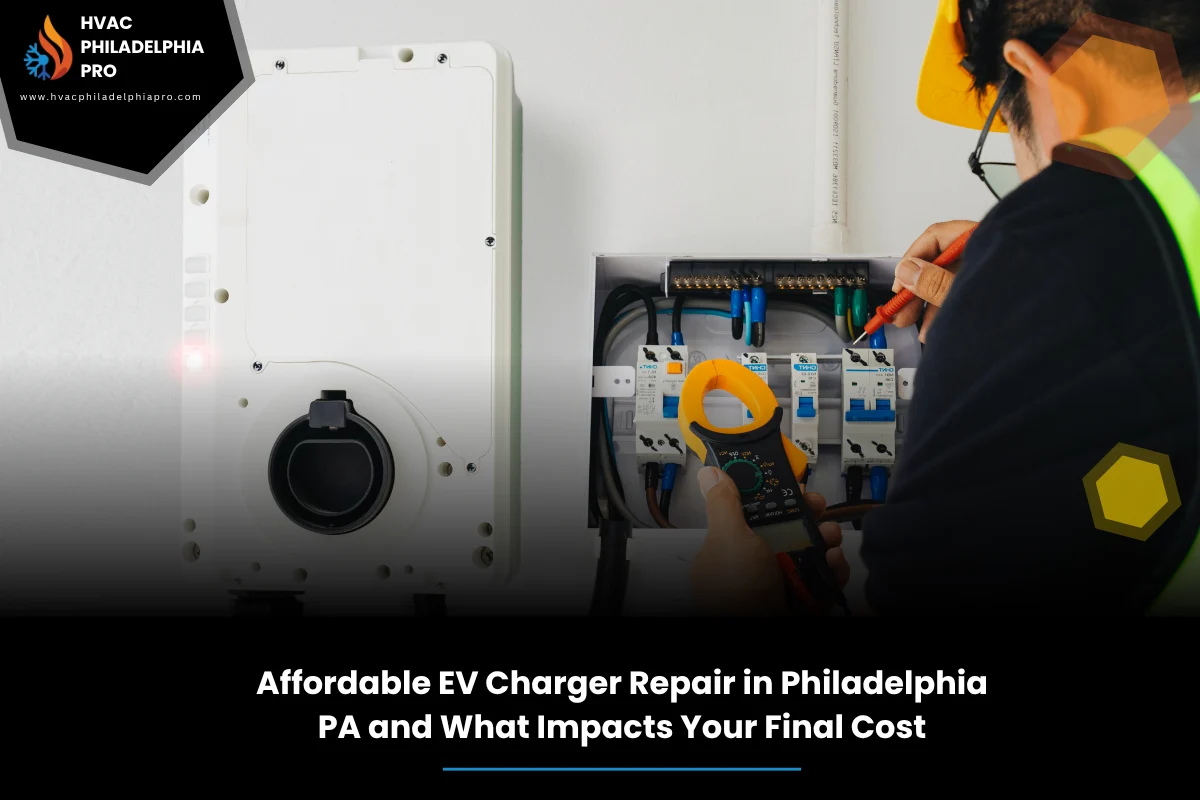
When your charger blinks, stalls, or just won’t start a session, it’s tempting to panic. Take a breath. You can sort this out step by step and avoid surprise bills. At the core, HVAC Philadelphia Pro believes clear checks and simple testing save time and money. If you understand what drives price, you can keep control of the fix from the first call.
We’ll break down what shapes the bill, from parts to labor to access issues. You’ll learn how to compare options, when DIY checks are safe, and when to stop and call a pro. This guide aims to keep affordable EV charger repair in Philadelphia PA realistic, predictable, and safe for your home or small business.
If you need hands-on help right now, you can look into affordable EV charger repair in Philadelphia PA for more details about service availability and scheduling.
Table of Contents
Quick Summary
EV charger repair costs come from three main buckets: diagnosis time, parts, and site conditions. Small fixes like firmware updates or connector cleaning tend to be quicker. Board or power module replacements take longer and need parts sourcing. Public sites add network checks, access windows, and safety steps that stretch labor.
Start with safe resets and photos of errors. Confirm warranty before paying out of pocket. Ask for a scoped quote that lists diagnosis fee, labor estimate, and parts line items. Compare timelines and part availability, not just price. Keep records so future issues are faster to solve. With a plan, you keep repairs cost-effective and avoid repeat visits.
What Actually Drives Your Charger Repair Cost
For a deeper dive into failure types, tools, and when to escalate, see the Complete Guide to EV Charger Repair in Philadelphia PA for Homes and Businesses, which complements this cost-focused article with broader troubleshooting steps.
Most repair bills come down to four levers: parts, labor hours, access, and documentation. A simple connector swap has low parts cost and clean labor time. A logic board or power module jumps parts cost and may add testing steps. Tight installs, conduit issues, or water exposure raise labor time and cleanup.
Networked units add cloud checks, RFID reader tests, or gateway resets. That means more steps before a fix even starts. Keep your app, firmware, and site Wi-Fi stable. Good prep reduces diagnosis time and keeps the visit focused on the root cause, not chasing side issues.
Common Faults and What They Mean for Cost
Many calls start with the same symptoms: the car won’t start a session, the charger shows a ground fault light, or the connector runs hot. Loose terminals, worn J1772 pins, tripped breakers, or GFCI faults are common. Moisture intrusion and UV-cracked cable jackets show up on outdoor installs.
Software snags also cause headaches. Out-of-date firmware, glitchy apps, or failed handshakes leave you stuck. A clean reinstall and firmware update can be a fast win. Hardware faults like pilot signal errors, overheated relays, or failed power supplies need parts and bench-level tests.
Public sites add more variables: cable strain from frequent use, card reader issues, bollard impacts, or pedestal leaks. Those require inspections beyond the head unit, sometimes including conduit checks and base repair.
Home vs Public Station Repairs: What Differs
At home, Level 2 chargers run on a 240V circuit. Public sites may mix Level 2 pedestals with DC fast charging gear. According to the U.S. Department of Energy (2024), Level 1 uses a standard 120V outlet, Level 2 uses 240V, and DC fast charging delivers the highest power for quicker top-ups. U.S. Department of Energy Alternative Fuels Data Center: Charging at Home
Home work tends to be faster to access and simpler to schedule. You often deal with a single charger, known panel capacity, and a short cable run. Public station work may include network diagnostics, signage control, off-peak access windows, and added safety barriers, which stretch time on site.
If your site uses a networked plan, you may need to coordinate with the network operator for logs and remote tests. Save time by gathering timestamps, error codes, and recent maintenance notes before the visit.
Price Ranges You Can Expect in Philadelphia
Repair prices vary with scope, parts, and access. The table below shows common tiers for Philadelphia projects. These are ballpark ranges, not quotes.
| Scope | Typical examples | Estimated range (USD) |
|---|---|---|
| Basic | App or firmware updates, breaker resets, connector cleaning, minor water seal fixes | $100-$250 |
| Mid-range | Replace J1772 connector or cable, fix GFCI trips, repair wall mount, swap small control boards | $250-$600 |
| Advanced | Power module or main logic board, conduit or pedestal repair, load center work, DC fast diagnostics | $600-$1,500+ |
Actual pricing may vary depending on scope and requirements.
The fastest path to a fair bill is a clear scope: what’s broken, what tests prove it, and what parts fix it. Ask for the diagnosis fee, estimated labor hours, and part lead times on the quote. That way, timing and cost make sense before work begins.
Step-by-Step Cost Control Framework
Use this simple plan to keep costs under control from the first sign of trouble.
- 1) Document the symptom. Note lights, beeps, and app errors. Take clear photos.
- 2) Power cycle safely. Reset the charger and the dedicated breaker once.
- 3) Check the car on another charger, if possible, to rule out a vehicle-side issue.
- 4) Update firmware and app.
- 5) Verify warranty coverage. Many makers cover parts for a set time.
- 6) Call a qualified technician with your notes. Ask for a scoped quote with line items.
- 7) Approve the smallest fix that explains the failure.
- 8) Test the charger under load and save records for next time.
For deeper diagnostics steps, see the complete guide on this topic for broader repair logic.
DIY Checks You Can Try Before Calling
Start safe. Power off the charger at its breaker before touching hardware. Look for moisture inside covers or cracked cable jackets. Do not open sealed modules. Confirm tight plug-in connections on cord-and-plug units only. Keep it simple and stop if you feel unsure.
Update the app and charger firmware. Test Wi-Fi or cellular signal strength at the unit. Try a different vehicle or a public charger to isolate the problem. A careful round of these pre-checks often turns a service call into a quick fix or gives the tech a head start.
If the connector runs hot or shows pitting, stop charging and request an inspection. Heat damage spreads fast and raises cost if ignored.
Warranty, Parts, and Site Factors That Change the Bill
Warranty terms set the tone. Parts may be covered while labor is not. Confirm length, transfer rules, and exclusions. If the charger is within the window, open a claim before paying. A clear RMA process speeds approval and keeps costs down.
Parts availability matters. Common connectors and relays are quick. Main boards or power modules may need ordering. Outdoor installs with long conduit runs or pedestal repairs take more labor. Each site factor adds minutes and dollars, so share photos and panel details up front.
Keep serial numbers, install date, and prior maintenance logs in one place. Good records shorten diagnosis time.
How to Vet Technicians Without Overpaying
Searches like “best EV charger repair company in Philadelphia” aim to find quality, but ratings alone don’t show scope control. Ask three things: experience with your brand, a defined diagnostic path, and a written estimate with parts lead times. That separates price guesses from real plans.
Request proof of insurance and references for similar jobs. Ask how they handle no-fault finds and intermittent issues. A tech who explains test steps and exit criteria will likely finish faster and with fewer surprises.
Also ask about turnaround when a part is back-ordered. A safe temporary workaround can keep you charging while you wait.
When Repairs Are Not Worth It
Repairs make sense when parts are simple, in stock, and your unit is under warranty. If the charger is older, out of warranty, and the fix approaches half the price of a new unit, consider replacement. Look at performance, safety, and feature gains like better load sharing or smarter scheduling.
Factor in total cost of ownership: energy efficiency, warranty length, and expected lifespan. If your panel needs upgrades anyway, bundling that work with a new charger can reduce repeat visits later.
Keep your old logs, as they help set up the new unit and verify performance.
Comparison: Home vs Public Site Repair Focus
Here’s a quick contrast to set expectations before you schedule work.
Home: single charger, known panel, short cable run, easy access. Public: multiple units, network checks, access windows, bollard or pedestal repairs, and sometimes concrete or signage work. The public checklist is longer, which means more labor planning even before parts arrive.
For a broad reference on charger repair logic beyond costs, the complete guide to EV charger repair in Philadelphia PA for homes and businesses is a solid companion to this pricing overview.
FAQs
- How much does EV charger repair near me usually cost?
It depends on the fault, parts, and site access. Use the pricing ranges in this guide to frame your expectations, and always request a scoped quote before work starts.
- Do I need a permit to repair a home EV charger in Philadelphia?
Minor repairs often do not, but panel or circuit changes might. Check local requirements and discuss with a licensed electrician. When in doubt, ask your municipality for guidance before work begins.
- Why does my charger trip the breaker or show a ground fault?
Moisture, damaged cables, weak connections, or a failing GFCI can cause trips. Start with safe resets and visual checks, then schedule a test to confirm the actual fault before replacing parts.
- Who handles EV charging station repair in Philadelphia for public sites?
Usually the site owner or property manager coordinates with a qualified technician and, if networked, the operator. Keep station IDs, error logs, and recent maintenance notes ready to speed the visit.
- Can I do home EV charger repair in Philadelphia myself?
Limit yourself to safe checks: app and firmware updates, power cycling, and visual inspection. Do not open sealed units or work inside energized panels. Call a pro for internal faults.
- How do I find the best EV charger repair company in Philadelphia without overpaying?
Ask about brand experience, diagnosis steps, and a line-item quote with part lead times. Compare timelines and documentation as much as price.
Conclusion
Smart prep and clear scoping keep affordable EV charger repair in Philadelphia PA within reach. Start with safe resets, gather photos and error codes, confirm warranty, and request a quote that spells out diagnosis, labor, and parts. Focus on the fix that explains the symptom, then verify performance under load and save your records.
When costs climb near replacement levels, weigh warranty, features, and long-term reliability. With a steady plan, you avoid guesswork and prevent repeat visits. Contact HVAC Philadelphia Pro for expert assistance. Use this guide to ask sharper questions, see through the noise, and make choices that fit your home or small business.
continue reading
Related Posts
See what drives EV charger installation cost in Philadelphia. Learn key factors, realistic price ranges, and a simple plan to avoid surprises and stay safe.
Plan affordable EV charger maintenance in Philadelphia PA with a simple yearly routine, DIY vs pro split, and a 5-step framework. Build safety, cut surprises, and keep charging reliable at home.
Get a clear view of AC installation cost in Philadelphia. See price tiers, key cost drivers, and a simple budgeting framework so you can plan smart and avoid surprises.