
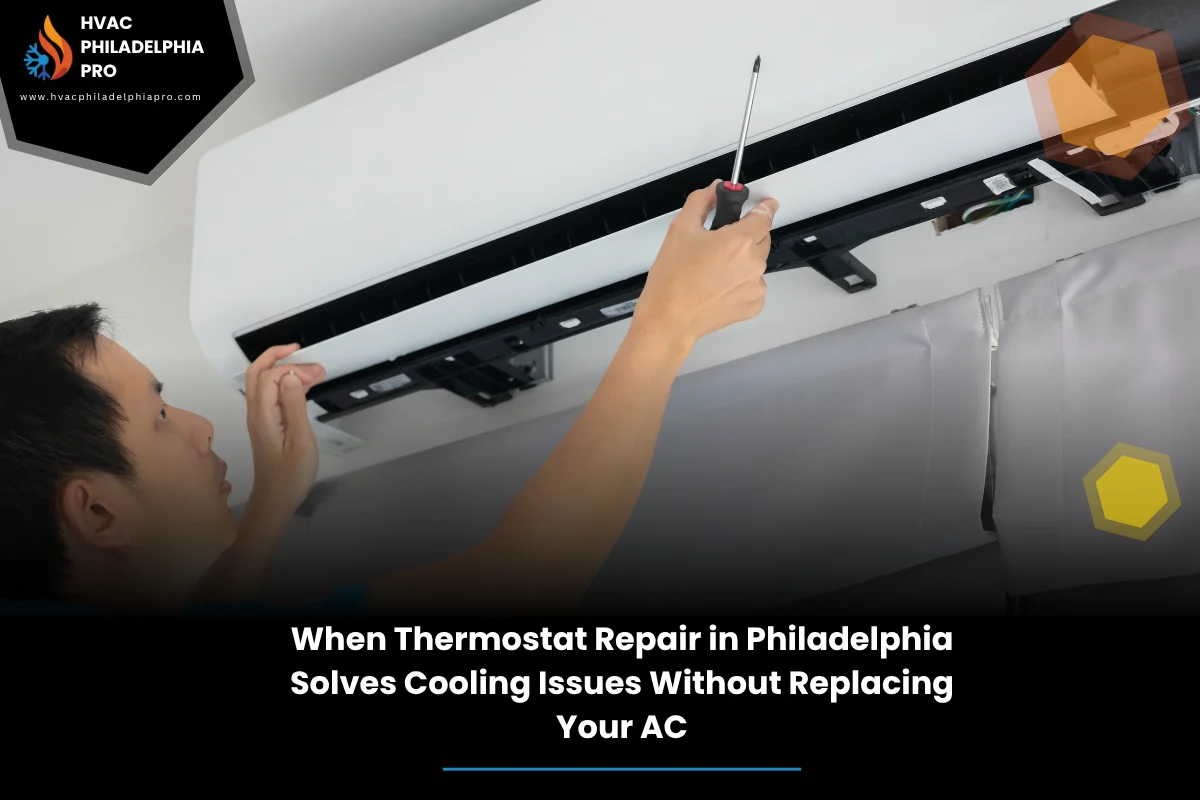
When your AC feels off, the fix might be small. Many cooling problems trace back to the wall control, not the outdoor unit. If you act fast, thermostat repair in Philadelphia can stop waste, lower stress, and bring back steady comfort. It is often simpler, safer, and way cheaper than swapping your AC.
The team at HVAC Philadelphia Pro sees this every week. Weak cooling, short cycling, or a dead start can all come from settings, batteries, wiring, or a tired sensor. If you need a quick path to help, you can learn more or schedule smart service for thermostat repair in Philadelphia with a pro who knows local homes and small businesses.
Table of Contents
Quick Summary
If your AC runs but rooms stay warm, or it starts and stops too fast, your thermostat may be sending mixed signals. Simple fixes often solve it: new batteries, corrected wiring, better placement, or a small settings tweak. Before calling for a full AC replacement, check power to the thermostat, confirm the mode and schedule, and inspect the air filter and vents.
This guide explains when a thermostat issue causes AC not cooling in Philadelphia, what you can safely test, and how a repair compares to a full system service. You will see clear signs, a step-by-step triage, and a table to weigh choices. The goal is to fix the real cause without overdoing it.
Signs the Thermostat Is the Real Problem
Look for these clues. Rooms do not match the set point. The thermostat screen fades or resets. The AC starts and stops in quick bursts. Or the fan runs but air feels warm. Often the fault is thermostat calibration, weak batteries, or a loose wire on R, C, Y, G, or W terminals.
If you want a wider view of cooling faults beyond the wall control, see the Complete Guide to AC Repair in Philadelphia PA for Comfortable Homes and Businesses. It explains system-level checks that pair well with the tips here.
How the Thermostat Drives Cooling and Where It Fails
Your thermostat senses room heat and signals the air handler and condenser to cool. When it reads wrong, everything drifts. Placement near a lamp, a sunny window, or a supply vent can fool it. So can dust inside the thermostat or a poor wire connection at the sub-base.
Two small settings matter: the cycle rate and the temperature differential. If the differential is too tight, the AC may short start. If it is too wide, you feel swings. Getting these right often changes comfort fast without touching the AC.
AC Short Cycling Fix From the Thermostat Side
Short cycling is rough on parts and power bills. Start simple. Swap in fresh batteries. Confirm cool mode and auto fan. Make sure schedules are not stacking setbacks. Then check for a clogged filter or blocked return, which can make a thermostat think the job is done too soon.
On many models, a tight deadband causes rapid starts. Loosen it by a degree or two. This alone can be your short cycling cure. If short cycling continues, a misread sensor or bad wiring to Y could be the next suspect.
When the AC Unit Not Turning On Is a Thermostat Issue
First, see if the thermostat screen is blank or dim. That often means dead batteries or no C-wire power. Then test the breaker and any furnace switch. If the screen is fine but nothing starts, the problem might be a tripped float switch at the air handler or a door panel switch.
If a safety trips, your thermostat cannot call for cool. Restore normal flow and reset. A stuck safety switch or a broken wire between R and Y will also keep the system silent even when the thermostat says cool.
DIY HVAC Troubleshooting in Philadelphia: A Safe 6-Step Framework
Use this quick path before you call. It keeps things safe and focused, and it pairs well with the city’s older row homes and mixed wiring styles. Also, if you want a broader repair roadmap, bookmark the complete guide on this topic for deeper system checks.
Step 1: Power and display. Confirm the thermostat wakes, shows room temp, and responds. Replace batteries if needed.
Step 2: Modes and schedules. Set cool, auto fan, and a steady hold. Remove any complex schedule for now.
Step 3: Filter and airflow. Replace a dirty filter. Open all supply vents. Clear furniture from returns.
Step 4: Breakers and switches. Reset the AC and air handler breakers. Flip the furnace or air handler switch off and on. Many smart thermostats need this to exit lockout mode.
Step 5: Location heat sources. Move lamps or electronics away. Close blinds on sunlit walls near the thermostat.
Step 6: Wiring glance. With power off, ensure wires are snug on R, C, Y, and G. If unsure, stop and call a pro.
Repair Paths: Thermostat Fix vs Full AC Service
Use this simple comparison to pick the next step that fits your case. It focuses on speed, scope, and risk control, not sales.
| Situation | Thermostat Repair Focus | Full AC Service Focus |
|---|---|---|
| Blank screen, fresh batteries do nothing | Check power to R and C, replace thermostat if failed | Verify control board fuse, low-voltage circuit health |
| AC short cycling fix needed | Adjust differential and cycle rate, relocate thermostat | Check charge, airflow, and controls timing |
| AC unit not turning on, thermostat appears fine | Validate Y call leaves thermostat | Test contactor, float switch, and safeties |
| Big temp swings room to room | Balance settings, correct placement | Duct balancing, zoning, or damper checks |
| New smart thermostat installed, issues begin | Confirm compatibility and setup | Assess control wiring and equipment interface |
Advanced Thermostat Issues That Imitate Bigger Failures
Smart thermostats can misbehave if setup skipped equipment type or O/B reversing valve options. Some need a steady power feed. Without a C-wire, they can reboot or drop Wi-Fi and miss calls for cool.
Older mercury units drift over time. A few degrees off the mark can make you think the AC is weak. Digital models can also lose accuracy if dust coats the sensor or if the case is not level on the wall.
When Thermostat Repair Will Not Solve AC Not Cooling in Philadelphia
If air is blowing but warm, and the thermostat calls for cool, look beyond the wall control. Frozen coils, low airflow, or a refrigerant issue will keep rooms hot. Outdoor fan off while the indoor blower runs is another sign you need system service.
In these cases, use your thermostat to test: set a lower temp and listen. If the condenser never starts, the problem sits downstream. This is when a full AC repair path, like in the city-wide AC repair guide, makes more sense.
Preventive Care: Placement, Calibration, and Smarter Settings
Keep your thermostat out of sun, drafts, and off exterior walls. Clean it gently and check level on the mount. Once a year, review schedules and cooling set points to match your routine. Small tweaks can limit runtime and keep rooms steady.
According to the U.S. Department of Energy (2023), adjusting thermostat settings by a few degrees during times you are away or asleep can cut cooling use while staying comfortable. U.S. Department of Energy Thermostats Guide
If rooms still drift, consider professional sensor placement or adding a remote sensor in the most lived-in space. This often solves hot-and-cold room complaints without touching the AC.
FAQ
- How do I know it is the thermostat and not the AC?
Match the set point to a simple room thermometer. If readings differ by several degrees or the screen flickers, start with the thermostat. If the condenser never starts when the thermostat calls, you may have a system fault.
- Can a bad thermostat cause AC not cooling in Philadelphia?
Yes. Wrong placement, wiring faults, or bad settings can make the system cycle poorly or not cool long enough. Fix those first before assuming a major AC issue.
- What is the fastest AC short cycling fix?
Replace the filter, widen the thermostat differential by 1 to 2 degrees, and confirm cool mode with auto fan. If short bursts continue, check thermostat wiring and sensor accuracy.
- Why does my AC unit not turning on even after I reset the breaker?
You may have a tripped float switch, a door switch open at the air handler, or a low-voltage fuse. If the thermostat is fine, the call may not reach the condenser.
- Should I upgrade to a smart thermostat?
It helps if your system is compatible and you have a stable C-wire. Smart scheduling and geofencing can cut waste, but setup must match your equipment.
- Do thermostat batteries really matter?
Yes. Weak batteries cause dim screens, missed calls, and random resets. Replace them once a year before the cooling season starts.
- Can thermostat repair void my equipment warranty?
Simple user steps will not. But wiring changes or board work should be done by a qualified tech to protect coverage and safety.
- What if thermostat repair does not fix my warm house?
Then shift to system checks: condenser contactor, airflow, refrigerant issues, or coil problems. The broader AC repair process will be the right path.
Conclusion
Before you rush into a big replacement, let the small stuff earn a chance. Many cooling complaints trace to the wall control, and thermostat repair in Philadelphia often brings quick relief. With a few careful checks, smart settings, and proper placement, your AC can run longer, steadier cycles and keep rooms even.
If simple steps do not bring back comfort, shift to a wider AC diagnostic path. Use what you learned here to describe the symptoms clearly and save time on the visit. Contact HVAC Philadelphia Pro for expert assistance. The right repair, at the right level, keeps your home or small business cool without the guesswork.
continue reading
Related Posts
Breaker tripping with EV charging? Learn what to do when your EV charger circuit breaker keeps tripping. Follow safe checks, a simple framework, and real fixes that last.
Stuck because your EV charger won’t charge vehicle? Use this clear homeowner checklist to fix power, settings, cable, and app issues before calling a pro.
Learn common issues and fixes for electric vehicle charger installation in Philadelphia. From panel limits to 240V circuits, grounding, and permits, get a clear, safe plan.