
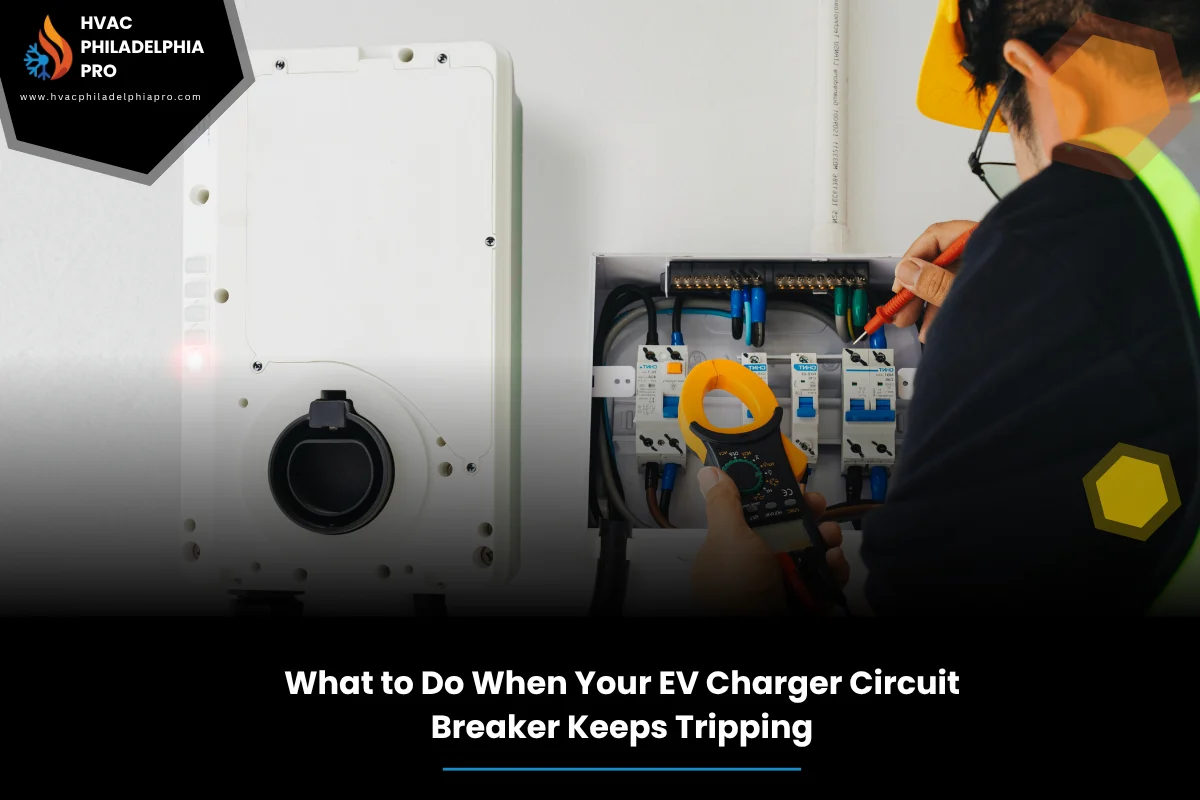
When your EV charger circuit breaker keeps tripping, it feels random and annoying. But breakers trip for reasons, and those reasons point to a fix. This guide shows you how to think through the problem, stay safe, and map out next steps without guesswork.
If your EV charger circuit breaker keeps tripping, use this walkthrough to understand likely causes and what a safe repair path looks like before you call anyone.
HVAC Philadelphia Pro works across heating, cooling, plumbing, electrical, and more, so we see how small wiring choices can snowball. Below you will learn the common patterns, quick checks, and a simple framework to narrow the fault.
Table of Contents
Quick Summary
Breakers trip to protect you from heat, shorts, or ground faults. EV charging is a steady draw, so weak connections, wrong breaker type, moisture, or a misconfigured charger often show up fast. Start by staying safe, then watch the pattern: instant trip, delayed trip, or only in certain weather or times.
Use a step-by-step approach: inspect, isolate, and test. Confirm a dedicated circuit, right breaker type, solid wiring, and correct charger settings. Avoid repeat resets. If you see heat marks, smell burning, or find corrosion, stop and call a pro. For deeper background, the complete EV charger repair guide can help you frame options without rushing fixes.
Why EV charger breakers trip in the first place
A breaker monitors current and trips when it senses too much heat or a fault. With EV charging, the load is steady for hours, so even a small wiring flaw builds heat until the breaker pops. That is the breaker doing its job as overcurrent protection.
Trips can come from overload, a ground fault, a loose lug, a tired breaker, wrong breaker type for the charger, or moisture in the circuit. For a deeper background on fault types, see the Complete Guide to EV Charger Repair in Philadelphia PA for Homes and Businesses for broader charger repair context and safe testing ideas.
Watch when it trips. Instant trips suggest wiring faults or GFCI response. Trips after minutes point to overheating from a loose connection or undersized wiring. Weather-based trips hint at moisture or condensation in the charger or outlet.
Safety first: what to do before any checks
Turn the charger off, and switch the EVSE breaker to OFF. Let things cool. Do not keep flipping it back on. That can mask the real issue and cook weak parts. Treat the panel like it is live at all times. If anything seems off, stop.
Check for heat or smell. Look for discoloration on the breaker, receptacle, or charger plug. Feel nearby surfaces for warmth. If you find any signs of burning or melting, that is a clear do not repeatedly reset situation.
Look for water, rust, or bugs in outdoor locations. Keep cords off the ground and out of puddles. Do not use extension cords for EV charging.
Common causes and what they mean
Wrong breaker type for the EVSE can cause nuisance trips. Some chargers need a GFCI breaker, others have built-in GFCI and require a standard breaker. Stacking both can trip fast. Match the charger instructions to the breaker type on the circuit.
No dedicated circuit or shared loads lead to overload. A car dryer or space heater on the same circuit will push amps over the limit. For Level 1 charging on a receptacle, loose backstabbed connections or a worn outlet can heat up and trip the breaker after a while.
Loose lugs in the panel or at the EVSE cause heat. Undersized wire for the breaker rating runs hot under continuous load. Moisture in outdoor boxes causes ground faults. A failing breaker or GFCI device can also misbehave, especially under steady draw. According to the U.S. Department of Energy (2022), EV charging should run on a dedicated, properly sized circuit with correct protection to ensure safe, reliable operation. U.S. DOE Alternative Fuels Data Center
Step-by-step framework to diagnose the trip
This simple plan helps you narrow the fault without special tools. Take notes as you go to build a clear story for a technician if you need one.
- Observe the pattern. Instant trip at plug-in, or after 5–30 minutes, or only on humid days. Pattern points to wiring heat, GFCI action, or moisture. Your notes become the isolation test later.
- Isolate the charger. If it is a plug-in Level 2, try a different known-good receptacle on the same rating if safe and available. For hardwired units, skip this step and continue.
- Lower the charger current. Many EVs and EVSEs let you set a lower amp limit. Drop it one step and try again. If it holds, the original setting was close to the circuit’s edge.
- Check the outlet and plug. Look for discoloration, loose fit, or heat marks. Replace worn receptacles before more tests.
- Confirm breaker and GFCI setup. If the EVSE has built-in GFCI, using a GFCI breaker can cause double protection conflicts. Follow the EVSE manual’s wiring note.
- Test weather impact. Dry the connector, keep it off the ground, and try on a dry day. If trips stop in dry weather, moisture is likely the trigger.
- Try another vehicle or another EVSE if possible. Cross-testing tells you if the fault follows the car or the charger. That speeds up root cause identification.
- If you need a deeper walk-through, see the complete guide on this topic for a full diagnostic flow and safe repair paths.
Comparison: symptoms, likely source, and first checks
| Symptom | Likely source | Quick check | First fix path |
|---|---|---|---|
| Instant trip at plug-in | Wiring fault or GFCI conflict | Check breaker type vs EVSE manual | Match protection, inspect wiring terminations |
| Trips after 10–20 minutes | Heat from loose lug or undersized wire | Feel for warmth, look for discoloration | Tighten lugs, verify wire size and breaker rating |
| Only trips in rain or high humidity | Moisture intrusion | Inspect covers, gaskets, cord ends | Dry, replace compromised enclosures or connectors |
| Works at lower amp setting only | Shared circuit or near-capacity wiring | Confirm dedicated circuit | Move to dedicated circuit or reduce charge rate |
| Random trips even at low load | Aging breaker or faulty EVSE | Cross-test with other car/charger | Replace breaker or service EVSE after tests |
Preventive habits that stop repeat trips
Keep a load management mindset. Set the EVSE or vehicle to a charge rate that leaves headroom on the circuit. Do not share the circuit with heaters or big tools.
Protect from water. Use proper in-use covers for outdoor receptacles. Keep connectors off the ground and out of puddles. Coil cords loosely and store clean and dry.
Schedule charging during cooler hours to limit heat buildup. Every few months, have an electrician check torque on lugs feeding high-load circuits. Small loosening becomes big heat over time. [IMAGE: Outdoor in-use cover protecting a charging receptacle from rain]
When to pause and call a pro
Stop DIY if you smell burning, see melted plastic, or feel heat at the panel or receptacle. These are clear signs of overheating and need proper tools to confirm and fix safely.
Call a licensed electrician if you find corrosion or water inside boxes, if a breaker will not reset and stay on, or if the breaker rating and wire size do not match the EVSE requirements.
Also pause if the EVSE manual conflicts with your current breaker type, or if cross-tests point to an internal charger fault. A technician can test insulation resistance, GFCI function, and current draw under load.
Better data: how to document the issue
Good notes speed repairs. Record dates, time to trip, weather, and charge settings. Photos of labels, breaker ratings, and any heat marks help a lot. That becomes your event timeline for the tech.
Use EV or charger apps to capture session starts, amps, and faults. For Level 1, only use metering tools rated for the load. Never open live panels or work on energized parts.
Keep all test attempts short. If it trips, stop and document. Repeated resets can hide the cause and damage components.
Warranty, manuals, and small details that matter
Read the EVSE install guide. Some units require or forbid specific GFCI setups. Following the manual prevents nuisance trips and keeps warranty intact. If in doubt, stick to the manual.
Write down make, model, and serial of the EVSE, plus breaker brand and rating. Firmware updates can fix charger quirks. Do not void coverage: do not open the charger enclosure unless the manual allows user service.
If a part needs replacement, match components by rating and type, not just by looks. Keep receipts and photos for future reference.
FAQs
- Why does my EV breaker trip right when I plug in?
Instant trips often point to a wiring fault, a ground fault, or a mismatch between the charger’s built-in GFCI and the breaker’s protection. Confirm the EVSE manual’s guidance on breaker type, then inspect connections for damage or moisture.
- Is it safe to keep resetting the breaker to charge?
No. Repeated resets can heat up weak spots and make things worse. Find the cause first. If you see or smell signs of heat, stop and call a licensed electrician.
- Can a Level 1 charger trip a 15A breaker?
Yes, especially on worn outlets, backstabbed connections, or shared circuits. Level 1 is a steady load for hours. A dedicated, properly wired circuit with a tight receptacle reduces trips.
- Do I need a dedicated circuit for my EVSE?
In most cases, yes. Sharing the circuit with other loads can push current over the limit and cause trips. Check your EVSE manual for required circuit size and protection type.
- Could the car be the problem, not the house?
It is possible. Cross-test with another EV or another charger if you can. If the issue follows the car, have the vehicle and portable EVSE checked.
- Why does it trip only when it rains?
Moisture intrusion can trigger GFCI trips. Inspect covers, gaskets, and cord ends. Keep connectors dry and off the ground. Replace compromised enclosures or seals.
- Will upgrading to a higher-amp breaker fix it?
No. Breakers must match wire size and the EVSE circuit rating. Oversizing a breaker defeats protection and is unsafe. Fix the cause instead of masking it.
- My charger works at lower amps. What does that mean?
That usually means the circuit is near capacity, there is a weak connection heating up at higher load, or the circuit is shared. Keep the lower setting and have the circuit inspected.
Conclusion
When an EV charger troubleshooting journey starts with a breaker trip, slow down and read the signs. Instant trips hint at faults or GFCI issues. Delayed trips point to heat and loose connections. Weather-based trips say moisture. Follow the steps above, document patterns, and match the charger to the right circuit and protection.
If your EV charger circuit breaker keeps tripping, stick with safe checks and avoid repeat resets. Use the quick tests, the comparison table, and your notes to narrow the cause. Contact HVAC Philadelphia Pro for expert assistance if you hit the limits of DIY or see heat, damage, or corrosion.
continue reading
Related Posts
Stuck because your EV charger won’t charge vehicle? Use this clear homeowner checklist to fix power, settings, cable, and app issues before calling a pro.
Learn common issues and fixes for electric vehicle charger installation in Philadelphia. From panel limits to 240V circuits, grounding, and permits, get a clear, safe plan.
Learn how to tackle outdoor EV charger installation in tight Philadelphia spaces. Get tips on power limits, weatherproofing, routing, and permits, plus a simple framework.