
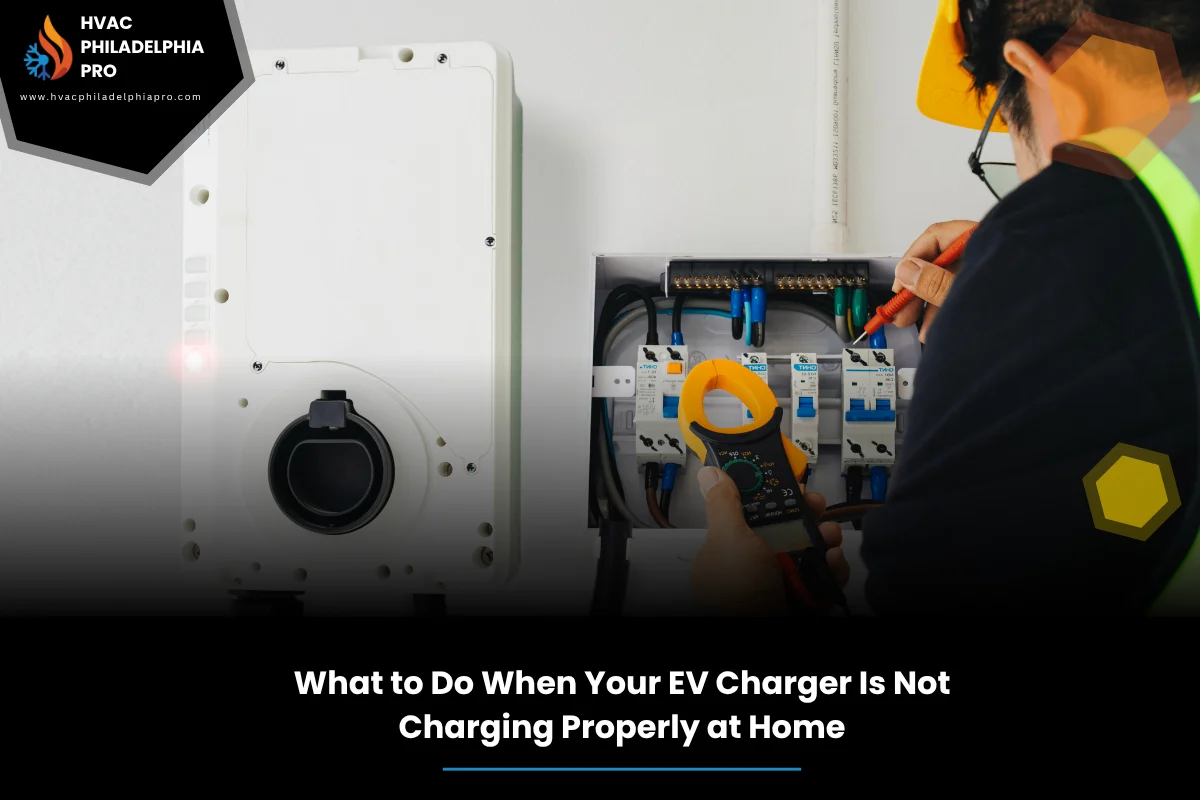
When your car sits there and the lights won’t start, it’s easy to panic. If your EV charger not charging properly is the problem, take a breath. You can run a few quick checks before calling anyone. And if you still need help, the team at HVAC Philadelphia Pro works on home electrical and charging gear every day.
If this stalls your day or keeps coming back, it may be time to get a pro involved. For focused help with an EV charger not charging properly, use that guide to see what a technician checks first and how routine maintenance prevents repeat issues.
This article shows fast ways to rule out simple causes, spot patterns, and pick safer next steps. It also ties into broader care, like the kind of EV charger maintenance in Philadelphia PA that keeps home charging steady through the seasons.
Table of Contents
Quick Summary
You can solve many charging hiccups in minutes. Start with safety and power down safely: stop the session, then check the breaker, outlet, and charger lights. Try a different outlet or circuit if you’re on Level 1. Reseat the connector, look for bent pins or dirt, and test without smart schedules or load limits. Reboot the charger and update firmware if the app shows an update.
If the unit still fails, try another vehicle or a public station to isolate the fault. Keep notes of error lights and sounds. Use an EV charger maintenance checklist to keep cables clean, vents clear, and screws snug. For condos, apartments, townhomes, villas, and single-family homes, the same basics apply: safety first, clear steps, and calm testing.
Why Your Home EV Charger Stops Charging
Most stoppages trace back to a few buckets: power supply issues, schedule conflicts, poor contact at the connector, or a protection trip like a ground fault. Some chargers pause when they sense heat, rain inside the port, or a loose plug. Others wait for a “start time” you set and forgot about.
For deeper maintenance routines and seasonal care, see the Complete Guide to EV Charger Maintenance in Philadelphia PA for Reliable Home Charging for long-term upkeep ideas that reduce mid-charge stops.
Quick Safety Checks Before You Touch Anything
Look for damage first. If you see scorched plastic, frayed cable, or a cracked case, stop and cut power at the panel. If it looks normal, verify the charger has power. Listen for a relay click at start, and check the status lights. Try a simple circuit breaker reset only once; frequent trips mean a real fault that needs attention.
Voltage matters. Level 1 uses 120V and Level 2 uses 240V; mismatched circuits or weak outlets can cause drops or heat. According to the U.S. Department of Energy, Alternative Fuels Data Center (n.d.), understanding your EVSE level and circuit rating helps avoid misdiagnosis and unsafe setups. U.S. Department of Energy AFDC: Charging at Home
The 10-Minute Diagnostic Flow
If you want extra depth on long-term care and tune-ups that back up this flow, check the complete guide on this topic for seasonal upkeep and record-keeping tips that make future troubleshooting faster.
- Stop the session in the app or on the unit. Wait 30 seconds.
- Confirm power at the outlet or breaker. Flip off, then on, once. Note any trips.
- Inspect the connector and port. Wipe dust, check pins, and seat firmly. Look for a locked latch.
- Bypass smart features. Turn off schedules, delay start, and step-by-step workflow timers. Try a manual start.
- Move loads. Turn off big appliances sharing the circuit. Try charging again.
- Reboot the charger and your vehicle’s infotainment. If the app offers firmware, update.
- Swap tests. Try a different cable if yours is detachable, or try another EV to isolate the issue.
- Document error lights or codes. Note time, temperature, and what changed.
Common Error Codes vs Likely Fixes
Names differ by brand, but most codes point to the same few causes. Treat any error code as a hint, not a verdict. Match the light pattern or code in your manual or app, then take the safest action below.
| Indicator or Code | What It Often Means | Safe First Steps |
|---|---|---|
| Ground fault / GFCI trip | Moisture, damaged cable, or leakage current | Dry connector, inspect cable, reset once at breaker, stop if it re-trips |
| Overheat / Thermal reduce | Hot weather, blocked vents, weak outlet | Cool-down period, clear vents, move sun exposure, try lower amps |
| Communication fault | Pilot signal issue, dirty pins, loose fit | Clean connector, re-seat firmly, try another vehicle if possible |
| Overcurrent / Overvoltage | Panel or circuit mismatch, spike | Reset once, avoid heavy loads, call for inspection if it returns |
| Schedule active | Charger waiting for start time | Disable schedule, start manual session |
EV Charger Maintenance Checklist for Reliability
A simple routine keeps charging smooth. Use this EV charger maintenance checklist monthly in homes, apartments, condominiums, townhomes, and villas, and quarterly for shared garages. The goal of preventive maintenance is to catch little issues before they snowball.
- Wipe connector pins and port edges with a dry, lint-free cloth.
- Check cable for nicks, kinks, or crushed spots; replace if damaged.
- Confirm the wall mount is tight; snug loose screws.
- Vacuum dust from vents; keep 6 inches of airflow space.
- Open the app; review charging logs and confirm no errors repeat.
- Verify breaker labeling and amp setting match the charger rating.
- Update firmware; note the version and date.
- Test a short 5-minute charge and confirm stable current.
Signs Your EV Charger Needs Maintenance
Watch for steady patterns. A one-off pause during a storm is normal; repeated stalls point to a cause. Common intermittent charging, hot plugs, buzzing relays, yellowed plastic near the plug, or frequent breaker trips all deserve a closer look.
Other signs your EV charger needs maintenance include slow ramp-up, app offline status, or a connector that feels loose in the port. If you can wiggle it and see charging start and stop, stop using it until inspected.
Local Notes: EV Charger Inspection in Philadelphia
If you need an EV charger inspection in Philadelphia, expect a visual, electrical, and app settings review. A pro checks panel capacity, breaker size, wire gauge, and grounding, then tests load while watching charger temps and logs. This pairs well with broader EV charger maintenance in Philadelphia PA for long-term reliability.
Timing matters when you rely on overnight charging. Weather swings, old wiring, and shared circuits can add stress. If a fault strands you before work, asking for same day EV charger maintenance in Philadelphia is reasonable, especially when a quick cable swap, app reset, or breaker move can get you back on track.
FAQs
- Why does my charger start, then stop after a minute?
- How do I know if the problem is my car or the charger?
- Is it safe to reset the breaker more than once?
- Why is my charger so hot to the touch?
- What app settings most often block charging?
- Do I need a dedicated circuit for a Level 2 charger?
- How often should I clean the connector and check the cable?
That pattern often points to heat, a loose connector, or a load kicking on the same circuit. Let it cool, reseat the plug, turn off nearby loads, and try again. If it repeats, log the time and call for an inspection.
Try a public station or a neighbor’s charger, and see if the car takes power normally. If it does, the home unit or circuit is likely at fault. If it fails everywhere, book service for the vehicle.
No. One reset is fine to clear a nuisance trip. If it trips again, stop. Repeat resets hide real faults and can cause damage or risk.
Some warmth is normal, but hot plastic or a soft, discolored plug is not. Heat can mean poor contact, high resistance, or overload. Pause charging and have the connection checked.
Schedules, delayed start, load limits, and utility rate timers are common. Turn them off, start a manual session, and re-enable them one by one after it works.
Yes, most Level 2 units require a dedicated 240V circuit sized for the charger. Sharing that circuit with big appliances can cause drops or trips.
Do a quick wipe and look-over monthly. In dusty garages or shared parking, check more often. Replace any cable with cuts, flat spots, or exposed wire.
Conclusion
When an EV charger not charging properly stops your routine, slow down and work the basics: power, connector fit, schedules, and a clean reboot. Most home hiccups show a simple cause if you test in order and keep notes. Back it up with routine care so small problems never grow into dead mornings.
Use the checklist above to keep cables clean, vents open, and settings sane. If you spot heat, trips, or repeated faults, pause and call for an inspection. Contact HVAC Philadelphia Pro for expert assistance. With clear steps and steady maintenance, your home setup stays safe, simple, and ready every night.
continue reading
Related Posts
Breaker tripping with EV charging? Learn what to do when your EV charger circuit breaker keeps tripping. Follow safe checks, a simple framework, and real fixes that last.
Stuck because your EV charger won’t charge vehicle? Use this clear homeowner checklist to fix power, settings, cable, and app issues before calling a pro.
Learn common issues and fixes for electric vehicle charger installation in Philadelphia. From panel limits to 240V circuits, grounding, and permits, get a clear, safe plan.