
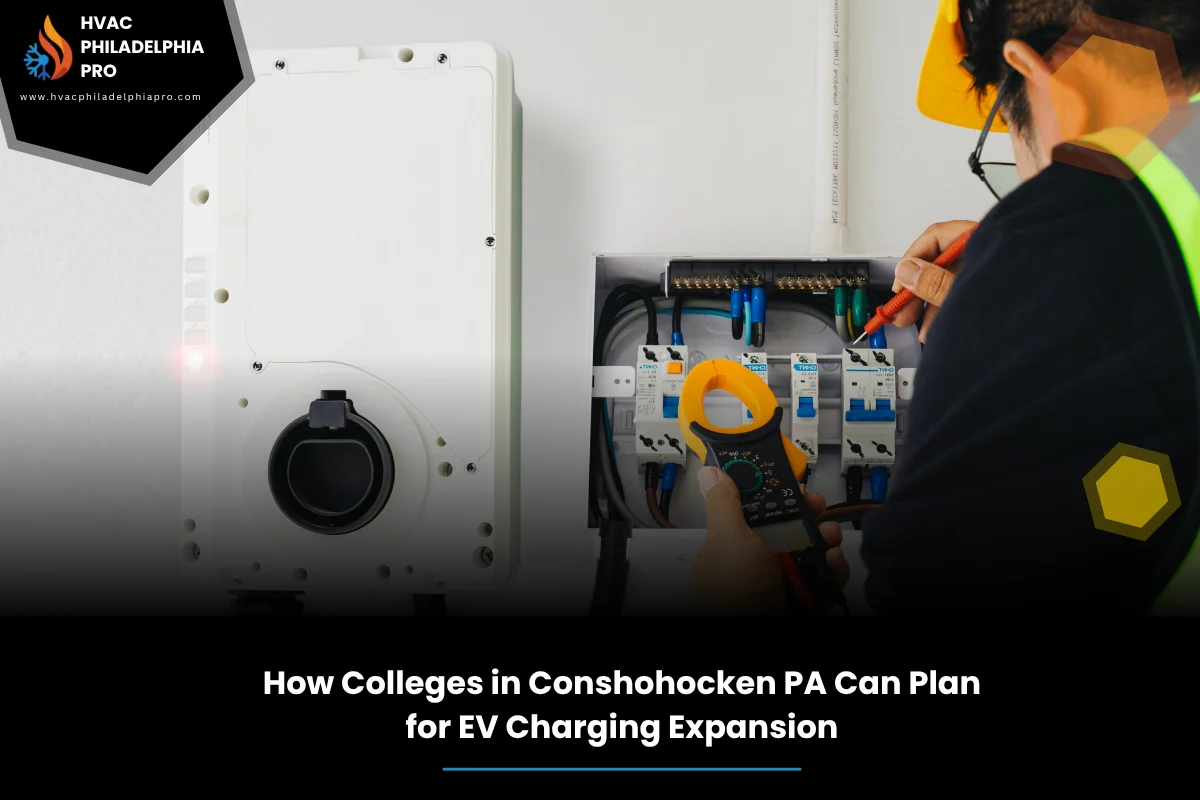
Colleges in Conshohocken are seeing more EVs on campus every semester. Planning now keeps lots orderly, power steady, and costs in check. This guide walks through a simple plan that any campus team can follow. We will touch site needs, power, hardware choices, policy, and student experience. You will also see where HVAC Philadelphia Pro fits into the bigger safety and facilities picture.
Your first step is to define scope and safety. Search policies, walk your lots, and check your panels. If you need a quick place to review the basics of permits, load, and hardware, start with EV charging station installation near me to understand what a compliant installation usually includes.
Table of Contents
Quick Summary
Start with a clear campus charging roadmap. Count drivers, plan for growth, and match charger types to dwell times. Use a phased build so you learn fast and waste less. Right-size power, add smart controls, and document safe operations. Align with grants and partners when helpful. Keep the student and staff experience simple, fair, and reliable.
The big wins come from a smart site plan, flexible conduit, and load management that avoids surprises. Level 2 hubs near long-stay parking fit most college needs. Data from a pilot informs the next phase. Keep signs clear, costs transparent, and maintenance steady. You will build a system that scales without chaos.
Why Plan EV Charging on Campus Now
EV adoption grows year over year. Students commute, faculty park all day, and visitors need a quick top-off. Without a plan, you may see queues, tripped breakers, and confusion over who can charge where and when. Planning avoids rework and speeds approvals.
Future demand is hard to guess, but you can design for change. Use spare conduit, build power in reserves, and set policies you can update. For terms, parts, and install steps explained in everyday language, see the Complete Guide to EV Charger Installation in Philadelphia PA for Homes and Small Facilities and share it with your facilities team.
Think of this as campus future-proofing. You invest once in a solid backbone, then add ports as demand rises. That beats ripping up asphalt twice.
Mapping Campus Demand and Behavior
Start with a headcount. How many student, staff, and fleet EVs today? What about next fall? Note where they park and for how long. Long-stay parking fits Level 2. Short visits might use a few fast chargers.
Walk your lots to spot safe pull-in angles, lighting, drainage, and snow paths. Flag ADA routes and where signs should live. A quick site assessment now saves time during permits.
Choosing Charger Types for Colleges
Match charger speed to dwell time. Dorms and staff lots work well with Level 2. Visitor zones may need a couple of DC fast spots. Smart, networked units track use, set time limits, and handle payments.
When teams compare Level 2 charging to DC fast, remember power draw, utility demand charges, and downtime impact. Many campuses start with Level 2 hubs and add a small fast-charge corner later. For context, many programs talk about Level 2 EV charger installation in Philadelphia as a strong middle ground for cost and speed.
| Feature | Level 1 | Level 2 | DC Fast |
|---|---|---|---|
| Typical Power | 1 to 2 kW | 6 to 19 kW | 50 kW and up |
| Charge Speed | Very slow | Overnight or workday | 30 to 60 min top-up |
| Best Use on Campus | Dorm overflow | Dorms, staff, commuter lots | Visitors, fleet quick turn |
| Install Complexity | Low | Medium | High |
If you are weighing commercial EV charger installation in Philadelphia for mixed-use buildings on or near campus, the same logic holds: dwell time drives hardware, and hardware drives power and trenching choices.
Power, Load Management, and Safety
Before you buy hardware, check panels, feeders, and transformer capacity. Most colleges can add Level 2 ports with smart load sharing. This spreads available power across active vehicles so you avoid a heavy service upgrade.
Smart controls also align with your utility’s time-of-use rates. You can limit charge power during peaks and raise it at night. According to the U.S. Department of Energy, Alternative Fuels Data Center (2024), planning capacity with managed charging reduces peak demand and supports scalable growth for sites that add ports over time. U.S. Department of Energy: Alternative Fuels Data Center
Work with a licensed EV charger electrician in Philadelphia or the nearby area to review grounding, GFCI, fault monitoring, bollards, and e-stop access. Prioritize load management, fault protection, and clear labeling. That protects people and equipment.
A Step-by-Step Framework for Campus EV Expansion
Use this simple build path. It cuts guesswork, builds buy-in, and protects budgets. You can adapt for small or large campuses.
- Pilot program: Start with 6 to 12 Level 2 ports in one or two lots. Track use, dwell time, and charging windows.
- Data review: Compare demand by hour and lot. Decide ports-per-lot targets for the next phase.
- Backbone first: Add conduit, pull boxes, and spare capacity now. Add ports later as demand grows.
- Smart rules: Set time limits, idle fees, and payment options. Keep it fair and simple.
- Scale: Expand to dorms and commuter lots with what worked in the pilot. Repeat data checks each term.
If your team needs a refresher on core install steps while you map the pilot, skim the complete guide on this topic for plain-language fundamentals you can apply to campus sites.
Accessibility, Permits, and Wayfinding
Plan for ADA routes, curb heights, and reach ranges. Mark clear paths from stalls to sidewalks. Place screens and cables so users of all abilities can operate them safely. Good lighting and cameras help too.
Permitting varies by township, utility, and fire code. Keep one packet with cut sheets, one-lines, and site plans ready for reviewers. Build in time for utility checks, especially if you need a new service.
Do not forget signs. Stencil the pavement, mount clear signs, and add arrows at lot entrances. Strong ADA accessibility and wayfinding reduce misuse and improve turnover.
Operations and Uptime
Pick networked hardware with remote reboot, alerts, and open standards. This makes vendor swaps easier later. Set simple KPIs: uptime, session success rate, average idle minutes, and energy per day.
Schedule preventive maintenance for connectors, cables, and seals. Keep spares on hand. Train campus help desk staff to solve common issues first, then escalate to technicians.
Use dashboards to spot bottlenecks. If one lot is always full by 9 a.m., shift a few ports or adjust pricing. Small nudges reduce lines without big builds.
FAQs
- How many chargers should a college start with?
Run a short survey, then launch a pilot of 6 to 12 Level 2 ports in one or two lots. Use the data to size phase two. Most campuses expand in waves each term.
- Should we install Level 2 or DC fast first?
Most colleges begin with Level 2 for long-stay parking. Add a small DC fast corner for visitors or fleet needs once you see patterns.
- Do we need a service upgrade?
Not always. Smart load sharing often avoids a full upgrade. An electrician can check panels, feeders, and transformer capacity before you decide.
- How do we handle payments and idle time?
Use a simple app or campus card. Set time limits during the day and add idle fees to keep stalls moving. Post the rules on signs and in the app.
- What about winter and weather protection?
Choose outdoor-rated enclosures, check cable flexibility in cold, and plan snow routes. Bollards and wheel stops protect gear from plows.
- Can we use solar or batteries later?
Yes, if your backbone is ready. Conduit stubs, space on switchgear, and a clear pad near the lot make future add-ons smoother.
- Who handles repairs and software?
Many teams combine in-house checks with a vendor support plan. Make sure your agreement covers parts, labor, and remote updates.
- How do we align with city rules near Philadelphia?
Permits and utility steps vary by site. Work with a licensed EV charger electrician and check local guidance early to avoid redesigns.
As you plan, remember that the campus context differs from homes and small facilities, but the wiring basics carry over. The complete guide to EV charger installation for homes and small facilities is a helpful primer for new team members.
Colleges near Philadelphia that consider smart EV charger installation benefit from network features like usage caps, load balancing, and remote updates. Those tools keep costs stable and uptime high across busy terms.
In short, build flexible, manage power smartly, and keep the user journey simple from sign to socket. That approach scales well for growing EV demand in Conshohocken.
Wrap your plan with safety steps and clear roles. Your facilities crew, IT, sustainability office, and finance team should all own a piece. Contact HVAC Philadelphia Pro for expert assistance.
With a phased plan and steady data checks, your campus will meet demand without chaos. If you need a deeper how-to, your team can search for EV charging station installation near me details, then apply campus-specific policies. A calm, tested rollout beats a rushed one every time.
continue reading
Related Posts
Learn how to choose EV charger repair near me with clear safety checks, a simple shortlist framework, and provider comparisons so you can fix issues fast and right.
Power failures can freeze business chargers. Learn fast triage, common faults, and safe fixes for Marlton NJ sites, plus when to use emergency EV charger repair in Philadelphia.
Practical guidance for Springfield PA businesses on EV charging station repair in Philadelphia, with fast triage steps, safety basics, network vs standalone tips, and industry-specific advice.