
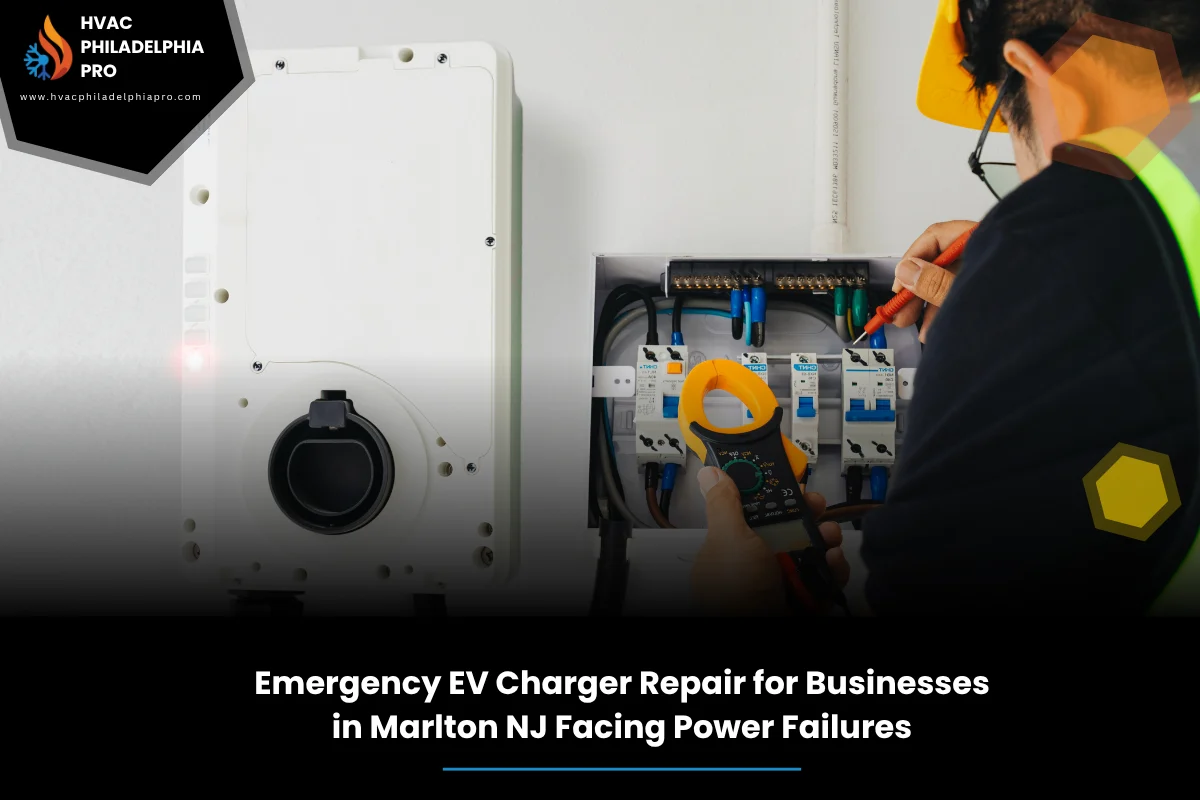
When the power blinks or surges, chargers can lock up, trip breakers, or block sessions. For Marlton NJ warehouses, distribution hubs, and commercial buildings, even a short loss of charging can stall shifts and deliveries. If the grid hiccups, you need a calm plan, quick checks, and a safe path to restore uptime.
HVAC Philadelphia Pro supports facility teams with practical steps that work in real sites, not just on paper. If you need fast help nearby, look into emergency EV charger repair in Philadelphia to limit downtime while you stabilize your operation. For clarity, we also explain how chargers fail during outages, how to triage safely, and what fixes prevent repeat issues.
In urgent cases, label hazards, make a brief log, and keep drivers informed. Then follow the checks below. If you must reference broader service details, you will find them in our complete guide to EV charger repair for homes and businesses, which this article builds on and localizes for business sites under power stress.
When the topic comes up in planning, remember your team can handle many first steps on-site. For deeper electrical work or high-risk faults, escalate. That keeps people safe and shortens the path back to normal operations. For immediate context, we cover what fails and why during grid dips and spikes.
Table of Contents
Quick Summary
Power failures hit more than the lights. Chargers sense faults and shut down to protect drivers and gear. The fastest way back online is a short, safe sequence: verify site power, check breakers, confirm network status, and reset the unit the right way. If the EV charger power failure came with a surge, inspect surge protection and upstream wiring before you resume use.
We outline common patterns like a ground fault lockout or a breaker that keeps tripping. You will see simple signs that point to the likely cause. We also share a RAPID framework to guide your crew through triage, isolation, and documentation, then handoff. If you need deeper references, our broader complete guide to EV charger repair for homes and businesses offers context on code, wiring, and safe resets.
Why Power Failures Break Business EV Chargers in Marlton NJ
Outages, brownouts, and fast flickers often cause an overcurrent or ground fault event. The charger’s control board sees unstable voltage and opens relays to protect the line. After power returns, some units need a manual reset or a clean power window before they allow another session.
If your team wants a fuller background on protection logic, surge events, and reset flow, read the Complete Guide to EV Charger Repair in Philadelphia PA for Homes and Businesses. It explains how home and business chargers respond to faults, which helps you match symptoms to likely root causes on-site.
Charger logic varies by brand, but the signs tend to repeat. If a display shows ground fault or a red LED sequence, treat it as a hard fault, not just a reboot issue. If the unit seems dead, confirm power at the panel first. In Marlton NJ, utility blips can line up with heavy HVAC loads, so timing matters.
Fast Triage When an EV Charger Is Not Working
Keep it simple and safe. First, alert drivers and place a sign. Second, verify building power is stable. Third, check the breaker for the charger circuit and note if it has tripped. Fourth, inspect the cable and connector for burns or cracks. Fifth, try a controlled reset following the maker’s steps.
If the EV charger not working shows a network or RFID error, swap to a known-good network path or test a local start if supported. If only one port fails on a multiport unit, isolate that port. Avoid repeated resets if a breaker trips again, since that points to a live fault.
Make a short log: time, fault code, steps tried, and result. This saves time later and helps spot patterns. If you see scorch marks, water inside the holster, or a buzzing sound, stop and escalate.
Electrical Panel, Breakers, and Load Management for Commercial Sites
Many outage issues trace back to supply. If the EV charger circuit breaker keeps tripping, look at panel load, breaker type, and wiring temperature. Heat, loose lugs, or an undersized breaker can trip even without a direct charger fault. If the breaker holds but the charger flags ground fault, suspect moisture or damaged insulation.
Right-size capacity and dedicated circuits matter. According to the U.S. Department of Energy (2024), EV charging equipment should match available electrical service and be installed per code for safe, reliable operation. Alternative Fuels Data Center: Electric Vehicle Charging Station Equipment
For Distribution Centers and Manufacturing Facilities running heavy motors, consider managed charging windows. Stagger start times so chargers do not align with compressor inrush or shift changes. In older Commercial Buildings, add inspection of neutral and grounding paths to rule out nuisance trips after storms.
The RAPID Framework for Outage Response
Use RAPID to move from chaos to order when power events hit. It keeps people safe and shortens your mean time to restore. Share it with floor leads and keep a printed copy near panels and charger kiosks.
R is Report: notify drivers, ops, and safety. A is Assess: confirm site power, scan fault codes, and note smells, heat, or damage. P is Protect: use lockout and tagout before opening panels or disconnects. I is Isolate: take the faulted unit out of service and keep working ports open. D is Document: capture photos, steps, and outcomes.
For reset logic, safety checks, and broader case examples, see the complete guide on this topic. It gives a deeper walk-through that pairs well with this quick field framework.
Temporary Workarounds vs Permanent Fixes
Your goal is safe uptime, not just any uptime. Use short-term steps only if they do not add risk. Then plan the permanent correction when the site is stable and parts are on hand.
| Scenario | Short-term action | Permanent correction | Risk if ignored |
|---|---|---|---|
| Breaker trips on start | Reduce concurrent loads; pause other chargers | Re-size circuit, verify wiring, tune load control | Repeat trips, wire damage |
| Ground fault code | Keep unit offline; test other ports | Dry/repair connectors, test insulation, replace seals | Shock risk, recurring lockouts |
| Brownout reset loops | Delay sessions until voltage is stable | Install surge protection, verify transformer capacity | Electronics wear, random failures |
| Network-only failure | Use local start if allowed | Restore network, swap modem or switch | Payment failure, lost usage data |
Do not bypass safety features. If a unit flags a persistent isolation fault, keep it out of service until tested. Most makes provide a safe test mode; follow the manual before any further steps.
Preventive Steps for Warehouses, Manufacturing, and More
Warehouses and Distribution Centers often stack loads during dispatch. Use a simple schedule so chargers do not peak with dock doors, conveyors, or forklifts. For Industrial Facilities and Manufacturing Facilities, add periodic torque checks on lugs and thermal scans during peak season.
Moisture is a frequent cause of nuisance trips. Keep holsters covered and clear drains near pedestals. After heavy rain, do a quick visual inspection before you resume operations. A quarterly EV charger diagnostic service helps catch cracked seals, worn cables, and weak contactors.
For Commercial Buildings, monitor utility voltage swings. If sags are common, consider a small UPS for control boards and a tuned reset sequence after restores. Keep spare labels, caution covers, and one tested spare cable on hand.
Common Patterns You Can Spot Early
Short hints help you act fast. A hot breaker face may mean loose lugs or undersized wiring. A hiss or buzz near the charger points to a failing contactor. A flashing ground fault LED after rain suggests moisture in the connector or pedestal.
Repeated resets without a stable session usually signal a real fault, not a firmware quirk. Swapping vehicles can rule out a car-side issue. If voltage at the panel looks low during shift change, stagger charging or trim current.
Much of this aligns with our broader discussion in the complete guide to EV charger repair in Philadelphia PA for homes and businesses, which explains fault logic and safe testing paths you can adapt to Marlton NJ sites.
FAQs
- What should I do first after a power failure if a charger will not start?
Warn drivers, verify stable building power, and check the charger breaker. If it trips again, stop resets and log the fault for escalation.
- Why does my charger trip the breaker only at shift change?
Other large loads may spike at the same time. Stagger sessions or reduce charger current, then review panel capacity and load control.
- Can I keep using one port if the other shows a ground fault?
If the unit allows, isolate the bad port and keep the good port open. Do not clear a hard fault without inspection.
- How long should I wait before resetting after an outage?
Wait until voltage is stable and connected gear boots fully. Then perform a single controlled reset following the maker’s steps.
- Is a network error the same as a power fault?
No. Network faults often allow local starts if enabled. Power faults involve electrical safety and need inspection first.
- Will surge protection stop all outage problems?
It helps protect electronics but cannot fix undersized circuits or moisture issues. Pair it with good wiring and seals.
- When should I call for diagnostic testing?
Call if breakers retrip, you smell burning, see damage, or get repeated ground fault codes. Document and isolate before calling.
Conclusion
Power failures are tough, but a steady plan keeps operations safe and moving. Start with clear triage, isolate faults, and document your steps. Use load scheduling, proper protection, and routine checks to lower repeat issues. If you need more structured support beyond this guide to Marlton NJ scenarios, consider emergency EV charger repair in Philadelphia to stabilize nearby sites fast.
This article pairs field steps with broader guidance so your team can act with confidence. Contact HVAC Philadelphia Pro for expert assistance. When your panels, breakers, and chargers all work in sync, drivers get reliable power, shifts stay on track, and you cut surprise downtime to a minimum.
continue reading
Related Posts
Learn how to choose EV charger repair near me with clear safety checks, a simple shortlist framework, and provider comparisons so you can fix issues fast and right.
Practical guidance for Springfield PA businesses on EV charging station repair in Philadelphia, with fast triage steps, safety basics, network vs standalone tips, and industry-specific advice.
Learn how home EV charger repair in Philadelphia habits protect Havertown PA homes. Spot faults, stop trips, and safeguard wiring with clear steps, tools, and prevention.