
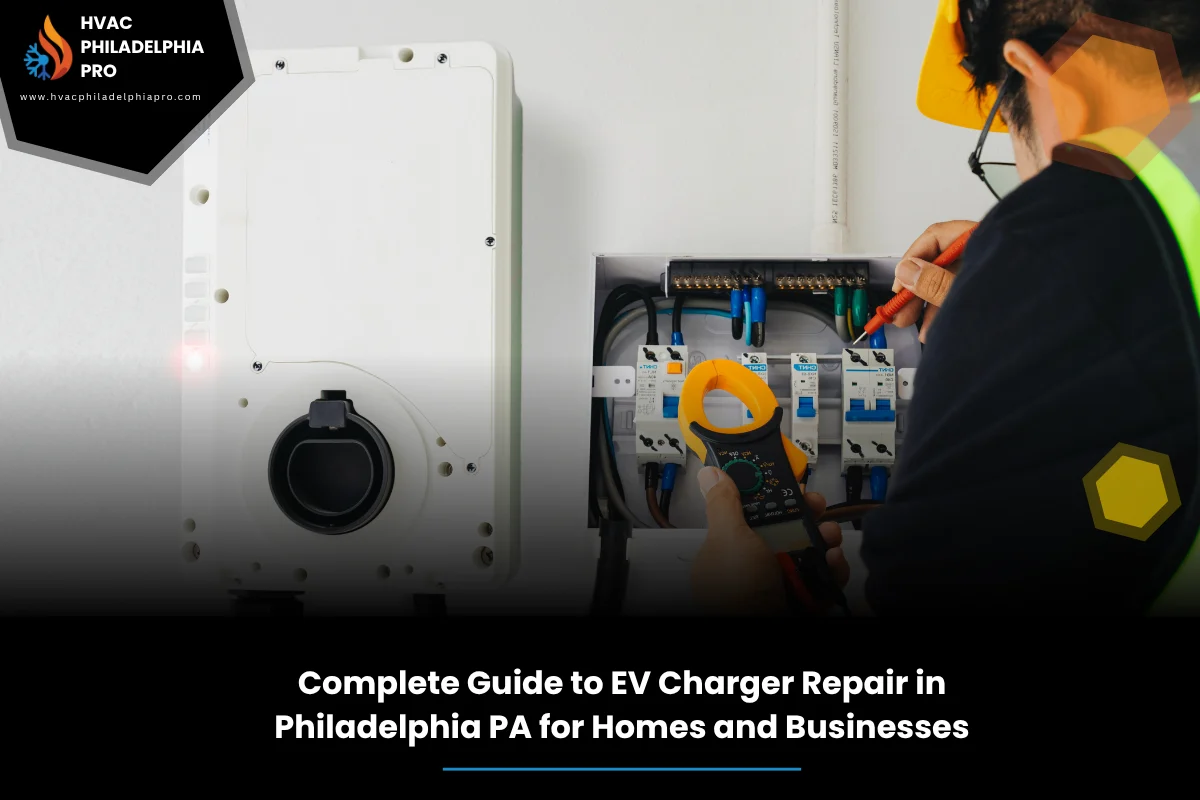
When your charger stops working, charging your car turns from routine to a real problem fast. This guide explains EV charger repair in Philadelphia PA in plain terms, so you can spot common issues, know what repair usually involves, and make better choices for homes and businesses. It also helps when the charger seems fine at first, then acts up, trips a breaker, or just will not start a session.
HVAC Philadelphia Pro works with residential and commercial systems across Philadelphia, including electrical equipment that people rely on every day. That practical background matters here. EV chargers connect power, safety devices, wiring, and user settings, so repair is rarely just one quick guess. A good repair starts with careful testing, a clear explanation, and the right fix for the actual fault.
This article covers home charging, business charging, common faults, repair steps, pricing factors, and how to decide what kind of help you need. If your EV charger not working issue keeps coming back, or your EV charger won’t charge vehicle at all, this guide gives you a solid starting point.
Table of Contents
Quick Summary
EV charger repair means finding and fixing the reason a charger cannot deliver safe, steady power to a vehicle. The problem may come from the charger itself, the breaker, the wiring, the connector, software settings, or the power supply feeding the unit. Good repair work starts with diagnosis, not parts swapping.
For homes, the most common calls involve a home EV charger repair in Philadelphia after power loss, charging faults, weather exposure, or repeated breaker trips. For businesses, EV charging station repair in Philadelphia often focuses on uptime, safe access, and keeping staff or fleet vehicles moving without long delays.
This guide also explains Level 2 charger repair in Philadelphia, brand-specific issues, pricing factors, and what to do during urgent failures. You will also find a simple framework for deciding whether the issue points to the charger, the electrical supply, or a site-wide problem.
What EV charger repair really covers
EV charger repair covers more than replacing a damaged cord or resetting a breaker. It includes testing voltage, checking wiring paths, inspecting connectors, reviewing fault codes, and confirming that the charger and vehicle can still communicate the way they should.
In many cases, the charger is only one part of the problem. A weak connection in the panel, a worn breaker, moisture at the unit, or a grounding issue can all cause charging to fail. That is why an EV charger electrician in Philadelphia should look at the full circuit, not just the wall unit.
Homeowners often call when the EV charger power failure seems random. Businesses usually notice patterns first, like one station dropping offline or charging sessions stopping during busy hours. Both cases need the same thing: a clear test process and a safe repair plan. How EV Charger Diagnostic Service Solves Common Charging Problems at Home
Once the source is confirmed, repair may involve breaker work, wiring correction, connector replacement, internal charger component repair, or control reset. The right scope depends on what testing shows, not what the symptom looks like at first glance.
Common signs your charger needs repair
Charging fault symptoms usually show up in a few repeat ways. The charger may power on but never start charging. It may begin a session, then stop after a few minutes. Or the vehicle may reject the charger and display an error.
Other signs are easier to miss. A connector that feels loose, a charger that runs hot, lights that blink in a new pattern, or a breaker that trips only on some days can all point to an electrical fault. These are not small details. They often show where the failure starts.
If you are dealing with an EV charger won’t charge vehicle problem, basic checks can help narrow things down before repair begins. Confirm whether the vehicle charges at another station, whether the charger has power, and whether the fault repeats at the same point in the session. Homeowner Checklist When an EV Charger Will Not Charge Your Vehicle
Do not ignore repeat failures just because a reset gets the charger going again. A charger that keeps failing often has an unresolved supply issue, internal fault, or damaged connection that will return.
Why breaker trips and power failures happen
Breaker trips are a warning, not just an annoyance. If your EV charger circuit breaker keeps tripping, the issue may involve overload, a wiring defect, moisture, a failing breaker, or a fault inside the charger. Repeated resets without testing can make things worse.
Power failures can also look like charger failure when the real issue sits upstream. A loose panel connection, voltage drop, damaged branch wiring, or another electrical problem in the property may interrupt charging even when the charger itself still works.
For that reason, EV charger electrical fault repair should include the full path from panel to charger. That is especially true with Level 2 equipment, which draws more power and exposes weak points faster than lower-power charging setups. What to Do When Your EV Charger Circuit Breaker Keeps Tripping
When the issue needs hands-on repair, a practical next step is a full inspection tied to EV charger repair in Philadelphia PA. That helps confirm whether the fault comes from the charger, the branch circuit, or the service equipment feeding it.
Home charger problems versus business charger problems
Residential EV charging and business charging fail in different ways because people use them in different patterns. At home, the charger often runs overnight on a set schedule. Problems show up as missed charging, morning surprises, or a breaker trip after a long session.
At commercial sites, charger use may be back to back, shared by several drivers, or tied to work hours. That means downtime affects more people at once. A single station failure can disrupt employee parking, tenant use, or fleet movement.
Home EV charger repair in Philadelphia often focuses on safety, wiring integrity, and reliable daily use. Commercial EV charging station repair in Philadelphia usually adds access control, shared use, traffic flow, and maintenance planning to the discussion. How Same Day EV Charger Repair in Philadelphia Helps Prevent Downtime
Same-day help matters more when the charger supports business activity, but homeowners may need it too, especially when the charger is the main way they keep a vehicle ready for work or school.
How technicians diagnose EV charger faults
Diagnosis is the step that separates a real repair from guesswork. A technician should inspect the unit, verify incoming power, check breaker condition, test voltage under load when safe, review visible damage, and look for fault indicators from the charger or vehicle.
For some units, diagnosis also includes app settings, network status, firmware behavior, or lockout conditions. That matters with smart chargers because software issues can look like hardware failure. A charger may appear dead when it is actually stuck in a control fault or communication error.
Choosing who performs that work matters. The person should understand both charger hardware and the electrical system feeding it, especially when the fault could involve the panel, grounding, or branch circuit. Choosing the Best EV Charger Electrician in Philadelphia for Reliable Repairs
A good EV charger diagnostic service ends with a plain answer: what failed, what still works, what repair is needed now, and what should be watched going forward.
Brand and equipment differences that affect repair
Charger type changes the repair path. A simple wall unit with basic indicators may be faster to test than a smart charger with app controls, load settings, and user access features. That does not always mean one is easier to fix, though. Sometimes the opposite is true.
Tesla Wall Connector repair often involves checking power supply, internal status lights, settings, and connection condition. ChargePoint charger repair and JuiceBox charger repair may also involve network behavior, app pairing, and communication settings in addition to electrical testing.
Level 2 charger repair in Philadelphia deserves special attention because these units support faster charging and place more demand on the circuit. If a Level 2 charger fails, the problem may involve heat, wire sizing, breaker performance, or wear at the connector after repeated use. Level 2 Charger Repair Best Practices for Industrial Facilities Using Heavy Equipment
No matter the brand, repair should match the exact model and site conditions. The same symptom on two chargers can come from two very different faults.
Pricing models and what affects repair cost
Repair cost factors usually fall into a few groups: diagnosis time, part replacement, circuit access, wiring condition, charger type, and urgency. Some jobs stay simple because the issue is limited to a breaker, connector, or resettable fault. Others take more time because the problem sits in hidden wiring or a damaged charger assembly.
Business sites may also have access limits, multiple units, or scheduling needs that affect labor. Residential jobs can vary based on panel location, charger placement, and whether the fault appears only during long charging sessions. Emergency EV charger repair in Philadelphia can involve different scheduling demands than standard service.
That is why affordable EV charger repair in Philadelphia PA does not mean the same price for every call. It means the work matches the fault, the explanation is clear, and unnecessary repairs are avoided. Affordable EV Charger Repair in Philadelphia PA and What Impacts Your Final Cost
When you compare estimates, look at scope first. Ask what testing is included, what parts may be needed, and whether the quote addresses both the charger and the circuit feeding it.
Repair priorities for warehouses and distribution operations
Operational uptime matters when charging supports daily movement. In Warehouses and Distribution Centers, even one charger issue can slow routines if staff vehicles, support vehicles, or shared charging points depend on that station.
Repair planning in these settings should focus on access, safe cord management, repeat use, and quick fault isolation. A station that fails only during peak hours may point to a load issue, heat buildup, or a site condition that does not show during a short test.
Fast EV charger troubleshooting in Philadelphia helps narrow down whether the fault is local to one charger or tied to a wider electrical pattern in the building. That saves time and keeps repair work from drifting into trial and error. How Warehouses Can Reduce Downtime With Reliable EV Charging Station Repair
For sites that depend on regular movement, repair should also lead to a maintenance routine. Small issues tend to repeat when chargers stay in heavy rotation.
Distribution Centers face a similar problem, but often with tighter movement windows and more pressure on shared equipment. A charger outage can ripple into loading schedules, shift changes, and staging routines if no backup plan exists. Keeping Distribution Centers Moving With Fast EV Charger Troubleshooting in Philadelphia
That is why troubleshooting should document patterns, not just restore power once. The goal is to stop repeat downtime, not hide it for a day.
Repair planning for manufacturing and industrial sites
Site conditions shape repair needs in Manufacturing Facilities and Industrial Facilities. Dust, vibration, long operating hours, and heavy equipment movement can all affect charger reliability over time. A charger in these spaces may face harder use than a standard office parking setup.
For fleet vehicles, the repair plan should consider how charging fits into shifts and production flow. If a charger fails at the wrong time, the problem reaches beyond one parking spot. It can affect transport inside the site or movement between facilities. EV Charger Repair Strategies for Manufacturing Facilities With Fleet Vehicles
In some Industrial Facilities, chargers also sit near equipment that adds electrical noise, heat, or physical wear. That does not always cause failure, but it can shape how a technician tests the charger and its power supply.
According to the U.S. Department of Energy, EV charging equipment works best when installation, use, and maintenance follow equipment and site requirements set by the manufacturer and electrical code guidance (U.S. Department of Energy). https://afdc.energy.gov/fuels/electricity_infrastructure.html
That broad point matters during repair. The charger must work with the site it sits in, not just pass a quick restart test.
Commercial building maintenance and scheduling
Maintenance planning helps Commercial Buildings avoid reactive repair cycles. If chargers serve tenants, staff, or shared parking users, one failure can create confusion fast. People may not know whether the issue is the charger, the app, the breaker, or the vehicle.
A simple repair and maintenance schedule can reduce that noise. It may include visual checks, connector inspection, testing after weather events, review of fault logs where available, and clear reporting when users notice charging interruptions. How Commercial Buildings Can Plan EV Charger Repair and Maintenance Schedules
This kind of planning also helps building managers separate one-off user errors from real equipment problems. That keeps service calls more focused and helps recurring faults stand out sooner.
Location-based examples for nearby service areas
Location context matters because site layout, weather exposure, and property wiring can shape the repair path. A residential charger mounted outside may face different wear than one inside a garage. A business charger in a shared lot may deal with more cable strain and user variation.
For example, residential EV charger repair in Upper Darby PA may focus on safe daily charging, outdoor exposure, and panel-to-garage wiring condition. The same core checks apply, but the home setup drives the details. Residential EV Charger Repair in Upper Darby PA for Safe Everyday Charging
Home EV charger repair in Havertown PA often comes back to protecting the wider electrical system, not just restoring charging for one night. If a charger fault keeps stressing the breaker or branch circuit, the repair should address that root issue. How Home EV Charger Repair in Havertown PA Protects Your Electrical System
Businesses in Springfield PA may need a broader review when charging stations serve employees or light fleet use. In that case, repair planning should include access, repeat use, and downtime impact. What Businesses in Springfield PA Should Know About EV Charging Station Repair
Emergency EV charger repair for businesses in Marlton NJ may center on EV charger power failure, sudden station outages, or charger faults that stop workday charging. The key is fast diagnosis with safe isolation of the affected equipment. Emergency EV Charger Repair for Businesses in Marlton NJ Facing Power Failures
And when people search EV charger repair near me in Lansdowne PA, they usually want a provider who can test both the charger and the circuit with a clear process, not just swap parts and hope. How to Choose EV Charger Repair Near Me in Lansdowne PA
Comparison table: common EV charger issues and likely repair paths
| Symptom | Possible cause | Typical repair focus |
|---|---|---|
| Charger has no lights or display | Power loss, breaker issue, wiring fault | Verify supply, inspect breaker, test branch circuit |
| Charger powers on but will not charge | Connector fault, communication issue, internal charger fault | Test connector, review fault codes, inspect unit controls |
| Charging starts then stops | Heat, unstable voltage, software issue, damaged cable | Load testing, cable inspection, settings review |
| Breaker trips during charging | Overload, moisture, failing breaker, ground fault | Panel testing, breaker review, charger fault isolation |
| Only one vehicle fails to charge | Vehicle-side issue or compatibility setting | Cross-test with another charger or vehicle |
| Outdoor charger works only sometimes | Weather exposure, loose connection, water intrusion | Enclosure inspection, connection repair, sealing review |
The table gives a starting point, not a final answer. Two chargers can show the same symptom and still need different repairs. That is why testing matters more than assumptions.
A simple framework for deciding what to do next
Decision framework helps you avoid random resets and wasted service calls. Start with three questions: does the charger have power, does the vehicle charge somewhere else, and does the fault happen every time or only under certain conditions?
If the charger has no power, check for obvious breaker trips and visible damage, then stop there. If the charger powers on but the vehicle will not charge, compare with another vehicle or station if you can do so safely. If the issue appears only during long sessions, think about heat, load, or unstable supply.
- Power issue likely: no lights, dead app status, breaker trip, repeated EV charger power failure
- Charger issue likely: visible fault lights, damaged connector, session stops at the charger
- Vehicle or pairing issue likely: one vehicle fails while others charge normally
- Urgent repair likely: burning smell, heat, repeated trips, visible damage, water exposure
This framework does not replace a technician, but it helps you describe the problem clearly. Better details often lead to faster EV charger troubleshooting in Philadelphia and a more direct repair plan.
FAQs
- What is the most common reason an EV charger stops working?
The most common reasons are power supply problems, breaker issues, damaged connectors, internal charger faults, or communication errors between the charger and vehicle. A proper diagnosis checks each of those instead of guessing.
- Can a charger work sometimes and still need repair?
Yes. Intermittent charging often points to heat, loose wiring, moisture, unstable voltage, or a failing internal part. If the issue repeats, the charger needs testing even if it starts working again after a reset.
- When should I call for emergency EV charger repair in Philadelphia?
Call quickly if you notice repeated breaker trips, a burning smell, visible damage, water exposure, or total charger failure that affects daily driving or business operations. Those signs can point to a safety issue.
- Does Level 2 charger repair differ from basic charger repair?
Yes. Level 2 chargers draw more power, so repairs often involve closer review of breaker condition, wire sizing, heat, and load behavior. The higher demand can expose electrical faults faster.
- Can businesses schedule repair and maintenance together?
Yes. Many business sites benefit from pairing repair with a maintenance review, especially in Commercial Buildings, Warehouses, Manufacturing Facilities, Industrial Facilities, and Distribution Centers where uptime matters.
- Will a tripping breaker always mean the charger is bad?
No. The breaker itself, the wiring, moisture, grounding problems, or overload can all cause trips. The charger may be the issue, but testing should confirm that before repair decisions are made.
- Do brand-specific chargers need different repair steps?
Often, yes. Tesla Wall Connector repair, ChargePoint charger repair, and JuiceBox charger repair can involve different controls, fault indicators, and software settings even when the power problem looks similar.
- How do I know if I need an EV charger electrician in Philadelphia?
If the charger has no power, the breaker keeps tripping, the circuit shows signs of stress, or the fault may involve panel wiring, you need someone who can inspect both the charger and the electrical supply safely.
Conclusion
EV charger repair in Philadelphia PA is really about safe power, steady charging, and solving the right problem the first time. Whether the issue starts with a home unit, a shared business station, a Level 2 charger, or a repeat breaker trip, the best path is careful diagnosis followed by a repair that matches the actual fault.
For homeowners, that often means restoring dependable overnight charging and protecting the electrical system. For businesses, it means reducing downtime, keeping charging access stable, and building a plan that prevents repeat failures. Either way, quick resets only go so far. Lasting repair depends on testing, clear answers, and solid electrical work.
If you are dealing with EV charger not working problems, recurring faults, or a charger that simply will not hold a session, use this guide as your starting point and then get the issue checked properly. Contact HVAC Philadelphia Pro for expert assistance. Done right, EV charger repair in Philadelphia PA keeps both homes and businesses moving without extra guesswork.
continue reading
Related Posts
Learn how EV charger installation in Philadelphia PA works for homes and small facilities, including charger types, permits, cost factors, and planning tips.
Learn how EV charger maintenance in Philadelphia PA helps keep home charging safe, steady, and reliable with practical tips, warning signs, and service planning guidance.
Learn how AC Installation in Philadelphia PA works, from sizing and ductwork to pricing, efficiency, and replacement decisions for reliable home cooling.